CNC300 release for greater production reliability in CNC cutting processes
22. May 2026
Anette Höchst, Head of the Textile Team in the Development Department, provides an insight into the latest release – and…

11. May 2026
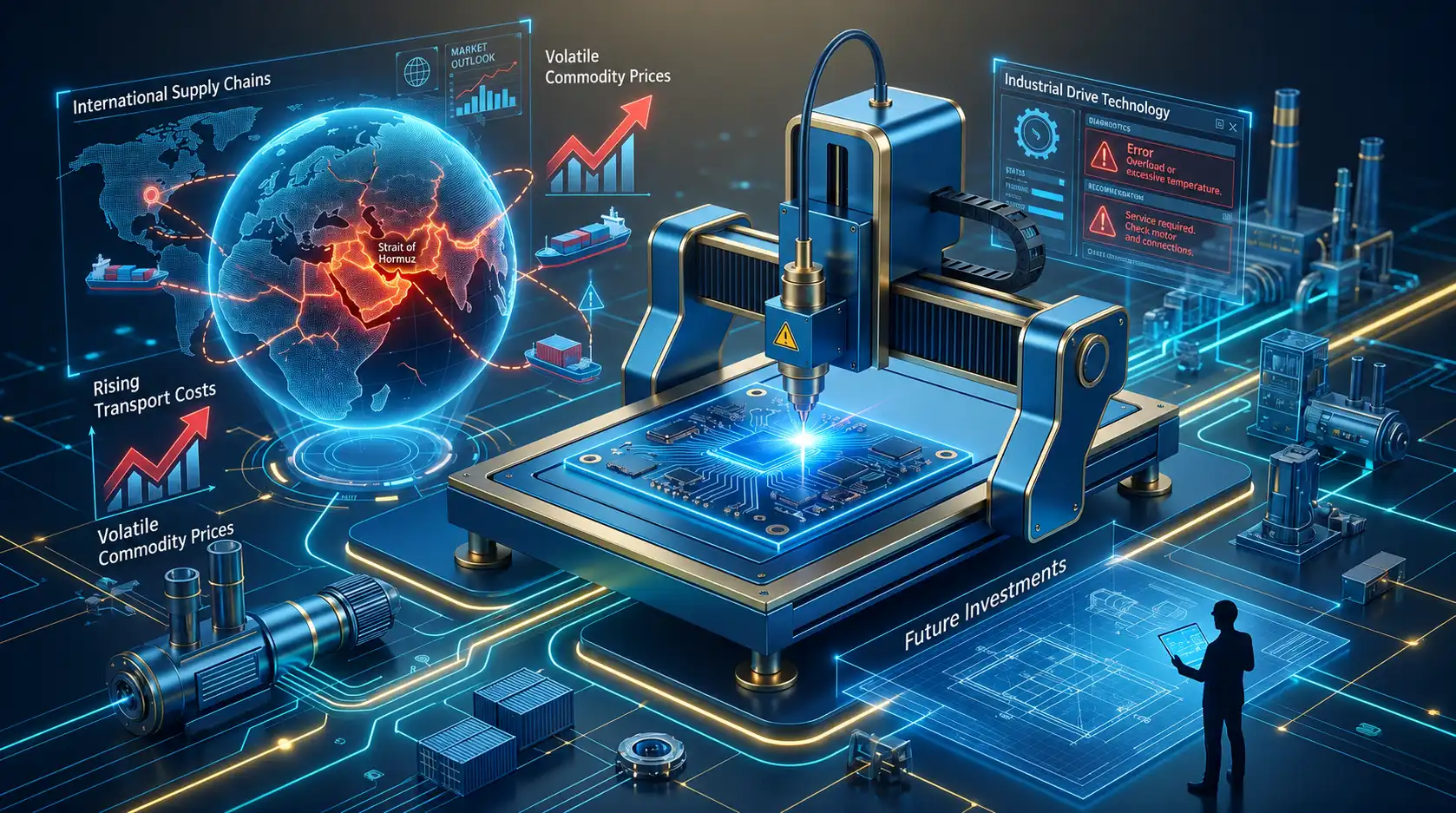
The growing tensions in the Middle East and the uncertainty surrounding the Strait of Hormuz are now having a noticeable impact on international supply chains. Sectors that rely on industrial drive technology, electronics and globally sourced components are particularly affected – including the CNC and cutting industries.
What once seemed to be purely a geopolitical issue is now affecting the day-to-day operations of many companies. Rising transport costs, longer delivery times and uncertainty over the availability of electronic components or spare parts mean that manufacturing plants and engineering firms must once again plan their investments with much greater foresight. This is because even delays affecting individual assemblies can have an impact on service calls, expansions or planned upgrades.
The Strait of Hormuz is one of the world’s most important trade and transport routes. Around a quarter of global oil shipments by sea pass through this region every day. International markets are therefore highly sensitive to political or military tensions in the region.
For industry, this means more than just rising energy prices. Logistics, material availability and international supply chains are also coming under increasing pressure. Sectors with a high dependence on electronic components, drive technology and industrial automation are particularly affected.
Modern CNC systems and digital CNC cutting machines, in particular, consist of a multitude of components manufactured internationally. Delays or price increases therefore often have a direct impact on production and investment processes, as well as on availability and planning reliability.

“The effects of such developments often take time to become apparent in the industry. In international supply chains in particular, prices and availability often do not react until weeks or months later.”
Alexander Faymonville, CSO by ProCom Automation
The fact that the situation is now having a tangible impact on industrial procurement and costing is already evident among leading suppliers in the automation sector.
Bosch Rexroth has announced material cost surcharges for various product ranges, effective 1 May 2026. A surcharge of 2.6% will apply to numerous components in future. According to the announcement, aluminium profiles will be subject to a material cost surcharge of as much as 19%.
Source: Corporate communications from the industrial supply sector, available from ProCom Automation
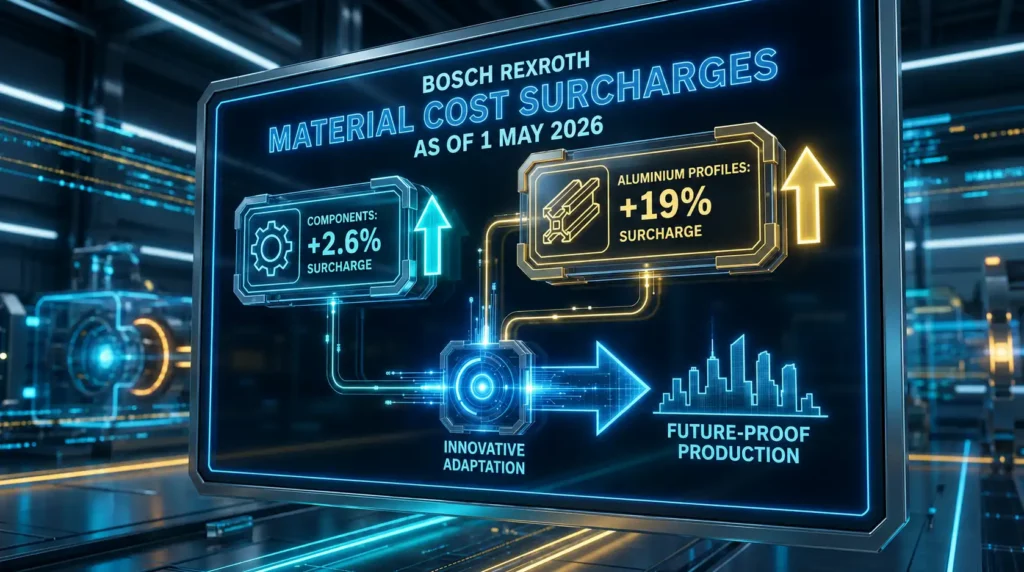
Among other things, the company cites geopolitical tensions in the Middle East and significant disruptions to global supply and logistics chains as reasons for this.
Other industry indicators also demonstrate just how sensitive industrial supply chains are at present. The VDMA recently reported a decline in new orders in the German mechanical engineering sector, whilst also highlighting the high level of uncertainty in international markets. At the same time, energy and transport costs are rising again in many sectors.
For the CNC cutting industry, this development is particularly relevant where machines consist of many internationally sourced components. These include, amongst others:
Even delays affecting individual components can result in service calls, retrofit projects or planned upgrades being postponed.
This applies to both machine builders and production facilities that work with CNC cutters from manufacturers such as Bullmer, for example. Particularly with automated cutting systems, delays in control components, drive technology or electronic assemblies can have a direct impact on expansions, service calls and retrofit projects.
For production facilities with business-critical CNC cutters, it may therefore be advisable to include not only standard spare parts but also key control components in their spare parts strategy at an early stage. Depending on system availability, production capacity utilisation and risk assessment, stocking a spare control unit may also be a sensible measure.
The key question is therefore no longer simply how geopolitical tensions affect industry in general. What is crucial, rather, is:
Many companies are therefore currently taking a much more strategic approach to investment and replacement purchases. Whereas planning was often carried out at short notice in recent years, issues such as supply reliability, production security and long-term availability are once again coming into sharper focus.
Some companies are now specifically increasing their stock levels of critical components or bringing forward planned modernisation projects. Particularly in the case of electronic assemblies, drive technology and spare parts, many businesses are seeking to mitigate potential risks at an early stage.

“Those who act early are usually the ones who weather such periods more calmly,” says Faymonville. “That is why many companies are now starting to plan their investments and replacement strategies with a much more forward-looking approach.”
Alexander Faymonville, CSO by ProCom Automation
At the same time, not all manufacturers are reporting acute shortages. In many sectors, supply chains are currently still functioning smoothly – albeit with significantly higher planning risks and growing uncertainty regarding prices, availability and delivery times.
“The war that has now broken out in the Gulf region and the resulting increase in geopolitical uncertainty will certainly not help export-oriented companies and their customers to overcome the global slump in investment,”
explained Dr Johannes Gernandt, Chief Economist at the VDMA, with regard to current developments in the engineering sector.
It is currently difficult to predict how the geopolitical situation will develop over the coming months. However, one thing is already clear: international supply chains remain a crucial factor for production reliability, investment planning and cost trends in industry.

For companies with CNC cutters and automated cutting systems, one thing in particular is therefore becoming increasingly important again: early planning, realistic timeframes and a strategic assessment of future investments.
Those who only assess investments, spare parts strategies or modernisation projects when there is an urgent need risk longer response times and reduced planning certainty. Companies that analyse at an early stage which components are critical and which systems should be expanded or modernised in the future, on the other hand, often gain a clear advantage.
At ProCom Automation, too, developments in the field of industrial CNC and drive technology are continuously monitored. Existing customers with CNC cutting systems were informed of the current market situation at an early stage. The aim is to identify potential risks in good time and to jointly plan realistic timeframes for spare parts, expansions or modernisation projects.
Growing uncertainties surrounding supply chains and industrial components highlight just how important a forward-looking spare parts and control strategy has become. Particularly in the case of business-critical CNC cutters, it can be advisable to stock up on key control components at an early stage.
ProCom Automation provides support in assessing existing systems, potential upgrades and long-term supply security.

About the author
Tanja is Head of Digital Marketing at ProCom Automation and writes practical articles on CNC, IIoT, Industry 4.0 and efficient manufacturing. The content is developed and technically reviewed in close collaboration with our Clouver IIoT monitoring and CNC experts.



You are currently viewing a placeholder content from Google Maps. To access the actual content, click the button below. Please note that doing so will share data with third-party providers.
More InformationYou are currently viewing a placeholder content from OpenStreetMap. To access the actual content, click the button below. Please note that doing so will share data with third-party providers.
More InformationYou are currently viewing a placeholder content from Facebook. To access the actual content, click the button below. Please note that doing so will share data with third-party providers.
More InformationYou need to load content from reCAPTCHA to submit the form. Please note that doing so will share data with third-party providers.
More InformationYou need to load content from Turnstile to submit the form. Please note that doing so will share data with third-party providers.
More Information