
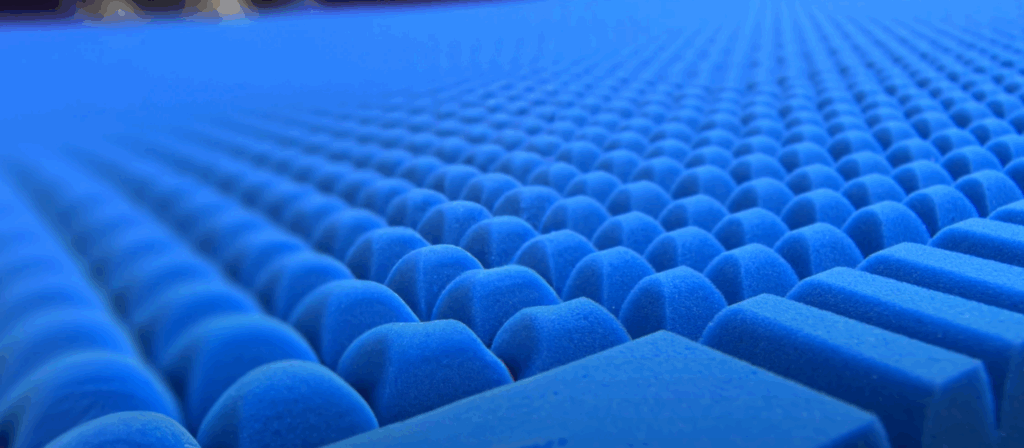
Contour cutting
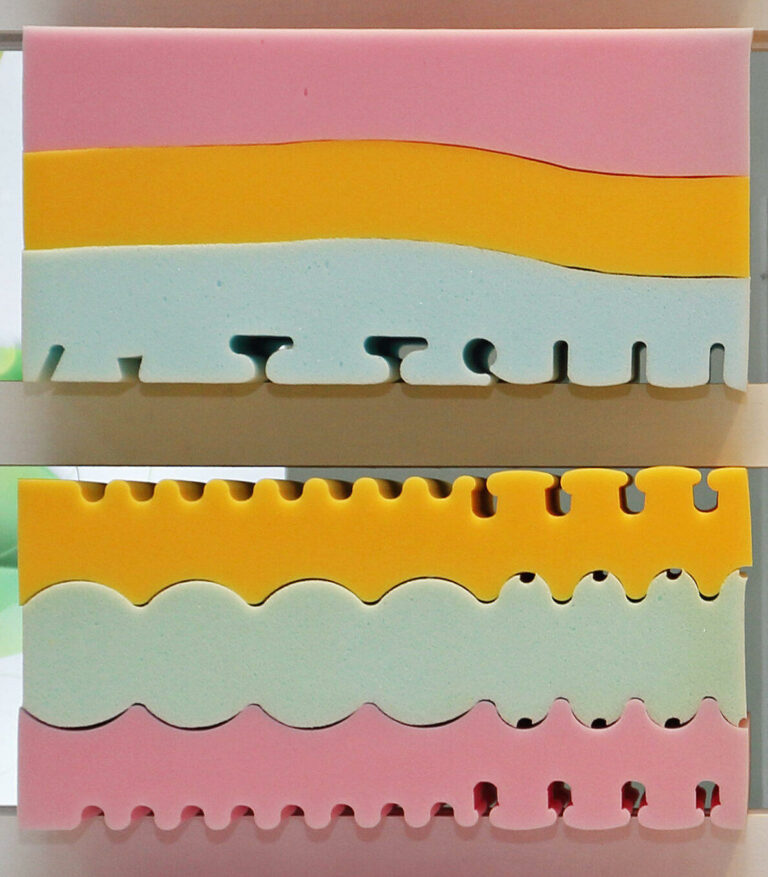
With the CNC300 control solution, there are no limits to the variety of contour cutting shapes. Integrated into the contour cutting machines from Fecken-Kirfel, the control solution impresses customers worldwide when cutting foam, caoutchouc, rubber, neoprene, and cork.
Precision for Machine Engineering
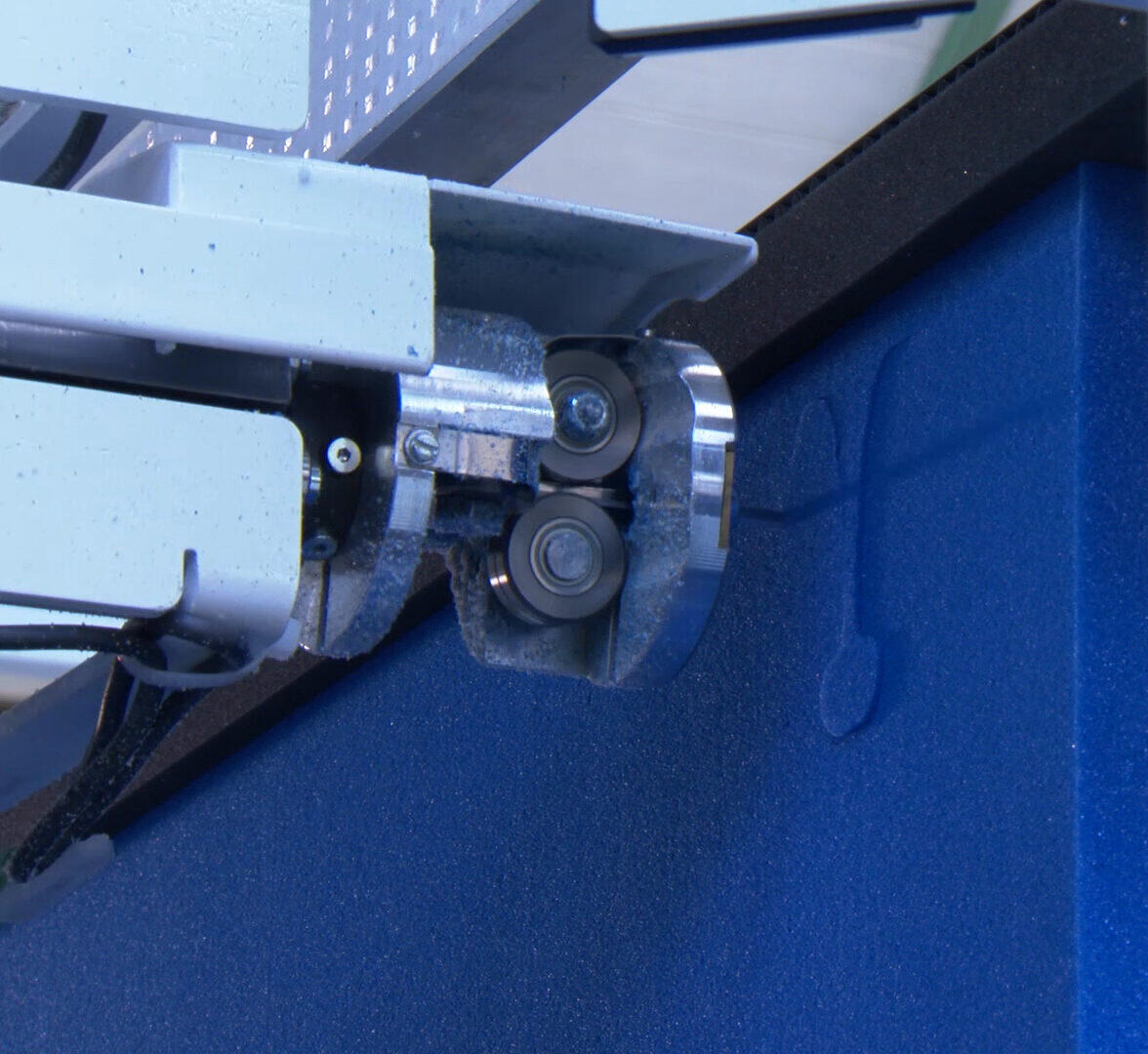
Whether in upholstery and mattress manufacturing or the packaging and automotive industry – worldwide Fecken-Kirfel’s customers are convinced by the control solution, which guides the revolving band knife with optimal material utilisation, highly precise cutting guidance, and maximum speeds. Discover the CNC control solution tailored to the requirements of 2.5D contour cutting with special algorithms.
The Control Solution's Highlights
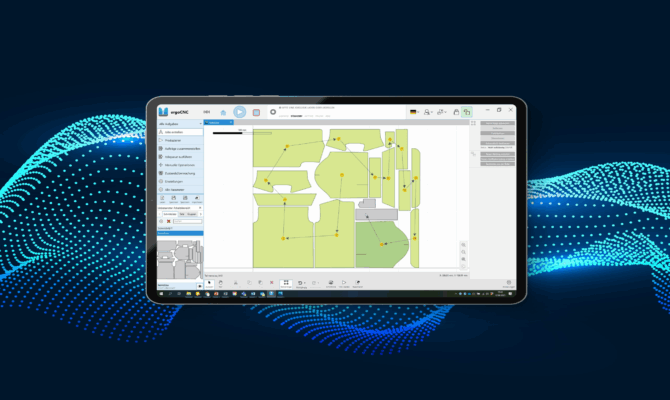
- Nesting and Routing with ergoCAM for optimal material utilisation and cutting line generation
- 2.5D cutting
- Fully automated or manual material transfer
- Automatic knife resharpening
- Knife guidance outside the contour
- Resuming after knife breakage within the material
- Automatic fixation of the block
- Material-specific speed regulation
- Integration into production lines via OPC UA
- Job Queue to prevent downtimes
- OPC UA Interface for gathering operational data and integrating the machine into prouction processes
- Integrated IIoT production monitoring with Clouver
“In ProCom, we have found a partner who has been supplying us with a first-class CNC control solution for decades, who reliably supports the evolution of our machines, and who is committed to our high quality objectives.”
Michael Tillmann, Fecken-Kirfel GmbH & Co. KG
In Action: Band Knife Cutting With the CNC300 Control Solution
Take a look at the ergoCNC® control solution in use at our customer:

INDUSTRY 4.0 PARTNER
Fecken-Kirfel, manufacturer of contour cutting machines equipped with the ProCom Automation CNC300 control solution, now offers its customers a simple and fast entry into digital manufacturing. As an operator of CNC cutting machines, you can easily obtain the IIoT production monitoring platform Clouver by ProCom Automation directly from Fecken-Kirfel. Take advantage of the benefits that targeted machine data analysis entails.
AI-generated visualization
Futher discover the variety of ProCom Automation control solutions


Frequently Asked Questions about Band Knife / Contour Cutting
Here you will find answers to the most frequently asked questions about band knife / contour cutting. Whether it concerns the first steps, typical applications, technical details or integration – here you will receive quick and easy-to-understand information.
General questions about band knife / contour cutting:
What is the difference between continuous band knife cutting and oscillating band knife cutting?
Both processes initially describe the type of cutting tool and its movement.
- In oscillating cutting, the band knife moves with a rapid reciprocating motion (back-and-forth movement). The oscillation can be realised mechanically or via the drive system, depending on the machine concept.
- In continuous band knife cutting, a closed-loop band knife runs continuously over deflection rollers.
What is band knife cutting and what are typical applications?
Band knife cutting is a cutting process in which a continuous or oscillating band knife separates material. It is used in a wide variety of applications, for example:
- Simple applications: cutting to length, trimming, splitting (straight cuts / layer separation)
- Complex applications: contour cutting (2D contours and – depending on the machine concept – also more complex 3D shapes through multi-stage processing)
The level of complexity that is possible depends primarily on the machine concept and the path planning/programming – not solely on the band knife as a tool.
Which materials are suitable for contour cutting?
Contour cutting is versatile and – depending on the cutting process and configuration – is used for a wide range of materials. Typical material groups include:
- flexible and rigid foams (soft/rigid foam)
- rubber/elastomers (e.g. neoprene, natural rubber)
- plastics of varying densities
- cork and similar materials
- felt, textiles and textile composites
- synthetic leather and comparable flexible sheet materials
Which materials perform well depends, among other factors, on material density, structure, friction, blade geometry, sharpness and the machine concept.
In which industries is contour cutting used?
Contour cutting is relevant wherever parts are produced from sheets or blocks in defined shapes, for example:
- mattress and upholstered furniture industry (contours dominate)
- packaging and protective packaging
- automotive (e.g. seals, acoustic/foam components)
- construction/insulation
- medical technology (depending on the material)
Whether simple cuts or complex contours dominate varies by industry and product.
What does “vertical” and “horizontal” mean in cutting?
“Vertical” and “horizontal” describe the orientation of the blade:
- Vertical cutting: the blade is positioned perpendicular (vertically) to the material being cut.
- Horizontal cutting: the blade is positioned parallel (horizontally) to the material being cut.
How the cut is created must be considered separately: depending on the machine, either
- the material moves relative to the blade (e.g. table/transport),
- the blade/tool carrier moves relative to the material,
- or both in combination.
What is the difference between textile cutting and band knife cutting?
The key difference lies in tool engagement and path planning:
- In continuous and oscillating band knife cutting, the blade is continuously engaged. Once the blade has entered the material, the process must be planned so that it navigates through the material in a controlled manner and exits again without damaging already cut parts.
- In textile cutting (cutter), the blade can typically be lowered and raised again: position tool → lower → cut contour → raise → move to the next part.
As a result, in band knife cutting (especially contour cutting), path planning is often a more critical factor than in many cutter applications.
Technical questions about the CNC300 control solution from ProCom Automation:
What advantages does the CNC300 control offer in contour cutting?
The CNC300 enables high productivity, process reliability and cutting quality in contour cutting – in particular through optimised path planning (routing) for contour cutting with continuous and oscillating band knives.
What special functions does the CNC300 offer in contour cutting?
The CNC300 is characterised by a wide range of intelligent functions:
-
Routing software:
-
Overall path planning across all parts to be cut (including entry and exit movements)
-
Consideration of the constraints of continuous band knives (e.g. limited blade rotation, necessary reverse rotations at suitable points)
-
Objective: shortest paths, as few additional movements as possible, high processing speed with good cutting quality
-
Routing is also used in other processes, but is particularly relevant for contour cutting with continuous and oscillating band knives.
- Nesting functions for material-efficient placement (as a preparatory step)
- Extensions such as 2.5D cutting (where provided by the process)
- Automatic resharpening with long-lasting grinding units
- Material-specific control of cutting speed
- Job/order management (e.g. job lists) to reduce downtime
- 3D visualisation for better representation of the resulting end products during job creation and also during the machining process
- OPC UA interface for integration into higher-level systems
-
How does the CNC300 support integration into existing production processes?
Via the integrated OPC UA interface, the CNC300 can not only provide operating and process data, but also support the integration of the machine into automated production environments – including connection to material flow/plant automation (e.g. higher-level control systems or line controls).
What support does ProCom Automation provide during commissioning of the CNC300?
ProCom Automation supports machine manufacturers in enabling fast commissioning and production ramp-up – with technical support and transfer of know-how. This allows our customers’ teams to reliably commission machines and systems at the end customer’s site and ensure a rapid start of production in the end customer’s plant.
Can the CNC300 be customised to customer requirements?
Yes. The CNC300 can be expanded through modular extensions and customised functional adaptations. Requirements are evaluated on a project-specific basis and – depending on feasibility and effort – implemented.
This might also be of interest to you


Yatai Ji
Key Account Manager
More Information? Reach Out to Us!
Learn more about our Clouver products and potential collaboration. Simply get in touch with us by phone or email. I look forward to a personal exchange!
- Phone: +49 241 93681-500
- Email: contact@procom-automation.de