Global tensions and supply chains in 2026: Why CNC operators should check critical components now.
11. May 2026
How global tensions are currently affecting the CNC and cutting industry The growing tensions in the Middle East and the…


22. May 2026
Anette Höchst, Head of the Textile Team in the Development Department, provides an insight into the latest release – and explains exactly what changes this brings for machine operators and commissioning engineers.
With the latest release of the CNC300 software, ProCom Automation has significantly expanded the functionality of its own control solution. However, the focus was not solely on new features or a modernised user interface. The central aim of the development was, above all, to achieve greater production reliability and even more robust support in real-world cutting operations.
In the textile CNC cutting industry in particular, challenges do not arise in theoretical test operations, but directly in ongoing production. Interrupted cutting processes, operator errors, incorrectly configured machines or unstable restart situations can quickly lead to downtime, material loss or costly rework.
This is precisely where the new release comes in.
“The main aim wasn’t simply to provide new features,” explains Anette Höchst, Head of the Textile Team within ProCom Automation’s development team. “We wanted to make the software even more robust in real-world production situations – particularly during restart processes, bite-feed or material-feed applications, and complex cutting scenarios.”
The development of this release was heavily influenced by real-world production conditions. Projects in Asia – particularly in China – placed new demands on operator guidance, restart procedures and production safety.
Whilst processes in many European plants are often clearly structured, production workflows in Asia frequently differ significantly in terms of operating culture, material handling and interventions in ongoing cutting processes. Particularly in heavily utilised production environments in China, this gives rise to requirements that rely much more heavily on flexible restart and operating concepts.
It is precisely this that has created requirements which traditional CNC systems have, until now, often had to address only to a limited extent.
“Many functions had to be made significantly more robust, because production processes often unfold differently in reality than originally assumed,”
explains Höchst.
The current release is already in use at several customer sites in China, where it supports real-world production processes under high workload conditions. The experience gained from this has been directly incorporated into the further development of the operating and restart functions.
A key focus of this release was on optimising production workflows relating to bitefeed and material feed processes, as well as restart scenarios during the cutting process.
Continuous cutting with material feed in particular gives rise to situations that are significantly more complex than traditional cutting sequences. Cutting processes are interrupted, material is moved, or operators must safely resume cutting processes following an interruption.
This becomes particularly critical with large parts that need to be cut in sections. If such a process is interrupted, the software must be able to track exactly:
The restart logic has been specifically enhanced for this purpose. Cutting windows and part sequences can now be recalculated, whilst improved part references and visual cues assist the operator in resuming the process.

The aim: less material wastage, fewer unplanned stoppages and more robust restart procedures during operation.
“It is precisely in the interplay between material feed, large cutting patterns and frequent interruptions that we have been working intensively over the past few months on more robust restart and operating procedures,”
as Höchst.
Another key feature of this release is the simplified handling of complex cutting parameters.
Until now, configuring material-specific settings often required in-depth process knowledge. Different materials, cut qualities or production requirements made parameterisation correspondingly time-consuming.
The new material tiles make this process significantly easier.
Operators can select pre-configured material profiles directly. All relevant cutting parameters are already stored behind each tile – for example, for denim, carbon fibre or other textile materials.

This significantly reduces the effort involved in manual configuration:
At the same time, the CNC300 retains its full flexibility. Parameters can still be customised, saved and reused for future jobs.
“The operator no longer needs to understand every setting in detail,” explains Höchst. “They simply select the appropriate material profile and can get straight to work.”
One of the most important new features is the monitoring of what is known as the remaining cutting path.
This feature helps operators to assess, even before starting a cut, whether the blade currently in use is likely to be sufficient for the job.
The software takes into account empirical data on blade wear specific to different materials. Individual cutting lengths can be stored for different materials.
For example, different reference values can be set for:
include directly in the calculation.
During cutting, the software continuously reduces the remaining cutting length and displays this directly on the interface.
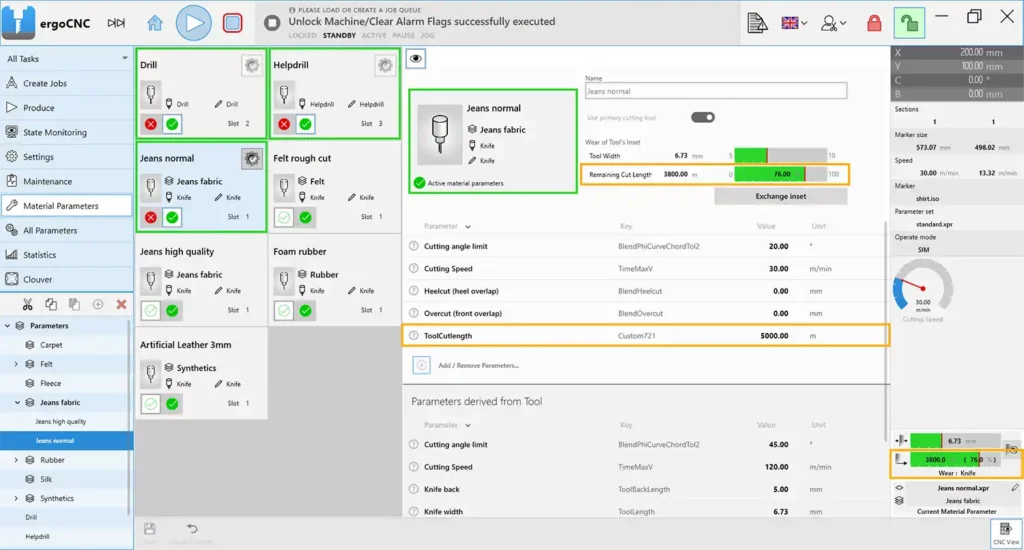
However, the real added value lies in production reliability.
If the software detects, before a new cutting pattern begins, that the remaining cutting length is likely to be insufficient, the operator can change the blade in good time – before any problems arise during cutting.
This can potentially prevent:
“It is particularly important for the operator to be able to tell, even before starting, whether the blade is still suitable for the job,”
explains Höchst.
In addition to monitoring the remaining cutting path, the blade width monitoring system has also been enhanced.
As the blade undergoes continuous changes due to cutting and grinding processes, the actual blade geometry directly influences the cut quality and process stability.
The control system must know exactly where the actual blade tip is located. Only then can contours be maintained precisely and corners cut completely.
If a blade that is too narrow is used, this can lead to:
The new interface therefore displays the current condition of the blade much more clearly and actively helps the operator decide when to change the blade.

In addition, camera-based solutions for automatic blade width measurement have already been integrated into the first bespoke projects. Following the grinding process, the actual width of the blade can be automatically recorded and incorporated directly into the calculation.
The integration of such image processing solutions is carried out on a case-by-case basis in collaboration with the respective customer and can be flexibly adapted to different production requirements.
“The operator can now see directly on the interface how much of the blade is left and how many metres they can expect to cut with it,”
explains Höchst.
The commissioning and parameterisation of the machines have also been specifically simplified.
New and enhanced wizards guide technicians step by step through the configuration processes and help to avoid common configuration errors.
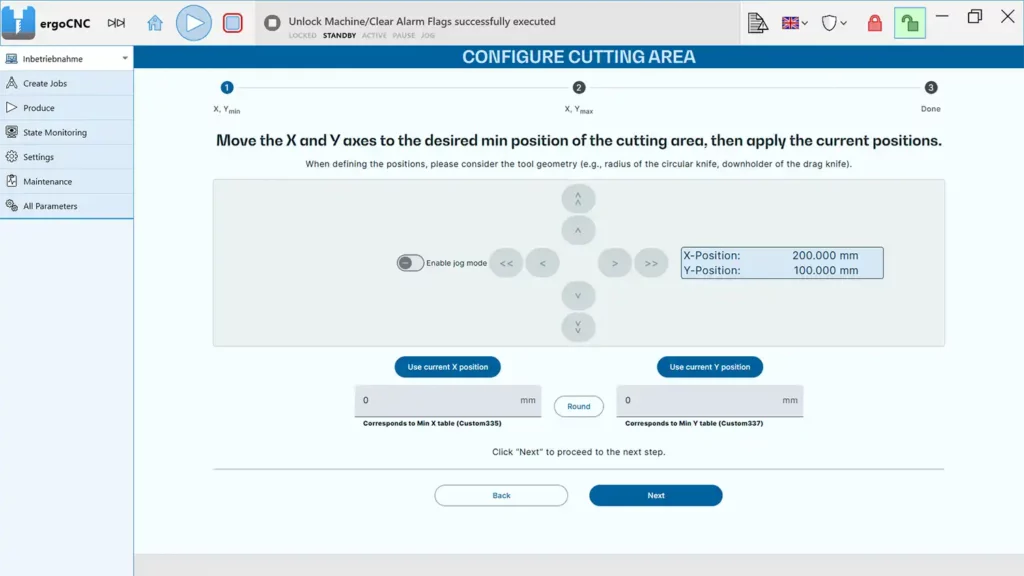
It has become clear, particularly in international projects, that additional dialogue prompts, help texts and guided workflows can significantly simplify commissioning and operation.
In addition, numerous parameter dialogue boxes have been visually redesigned. Settings are now displayed with graphical support, enabling operators to understand the effects of changes much more quickly.

This not only reduces the amount of training required; it also makes complex processes easier to understand and safer to operate.
In addition to stability and usability, overall software performance has also been improved.
In the past, complex cross-sectional views with numerous contours or curves could result in longer loading times. The new release significantly optimises these processes whilst also improving visual feedback during the loading process.
This optimises loading and response times and further improves the user guidance during complex loading processes.
The latest release has already been installed at several customer sites in China, where it is being used in real-world production processes.
The new features were tested directly in live production environments and further optimised in collaboration with customers.
In addition, new features such as material tiles and remaining cutting path have already been presented to international sales partners.
“The new approaches to material and blade monitoring in particular attracted a great deal of interest, as many companies face problems in this very area with unplanned blade changes and restart situations,”
explains Höchst.
International sales partners in particular showed great interest in features such as material tiles, remaining cutting path and transparent blade monitoring. A sales partner from Pakistan specifically highlighted the combination of the remaining cutting path display and material profiles as a practical aid to production processes.
This brochure presents the CNC300® control solution, including ergoCNC® and ergoCAM® – with features for blade cutting, strip blade cutting, material handling, process control and intelligent assistance systems.
With this latest release, ProCom Automation continues to refine the CNC300. Traditional machine operation remains a central component of the software, but is increasingly being supplemented by supporting and process-accompanying functions.
The focus is not on individual features, but on concrete improvements for day-to-day production:
Particularly in an industry where demands for speed, flexibility and process reliability are on the rise, this type of software-based production support is becoming increasingly important.
Development of the CNC300 is ongoing. Several of the features presented are already in productive use and are currently being rolled out gradually to further production environments. At the same time, ProCom Automation is working on additional enhancements relating to material tiles, remaining cutting path and intelligent operator support.
At the same time, the latest release clearly demonstrates the direction in which modern CNC control software is heading: towards intelligent process support with a focus on production reliability and traceable workflows in real-world manufacturing – without losing sight of traditional machine operation.
For those looking to make existing cutting processes more stable, reduce the operational workload and better manage production downtime, the latest CNC300 release offers new ways to optimise complex cutting processes.
Discover our control solutions for textile cutters

About the author
Tanja is Head of Digital Marketing at ProCom Automation and writes practical articles on CNC, IIoTIIoT is the internet-based networking of industrial machines, systems, and devices for data collection and process optimization., Industry 4.0Fourth industrial revolution through digitalization and intelligent networking of production facilities. and efficient manufacturing. The content is developed and technically reviewed in close collaboration with our Clouver IIoT monitoring and CNC experts.


You are currently viewing a placeholder content from Google Maps. To access the actual content, click the button below. Please note that doing so will share data with third-party providers.
More InformationYou are currently viewing a placeholder content from OpenStreetMap. To access the actual content, click the button below. Please note that doing so will share data with third-party providers.
More InformationYou are currently viewing a placeholder content from Facebook. To access the actual content, click the button below. Please note that doing so will share data with third-party providers.
More InformationYou need to load content from reCAPTCHA to submit the form. Please note that doing so will share data with third-party providers.
More InformationYou need to load content from Turnstile to submit the form. Please note that doing so will share data with third-party providers.
More Information