Industrial Retrofits: The Practical Guide to Modernising Your Machinery
13. March 2026
Your tried-and-tested machine is the heart of your production – mechanically robust, but technologically outdated. You are faced with a…


9. February 2026
The Smart Factory is the heart of modern industrial manufacturing: a highly networked, self-organizing production environment in which people, machines, systems, and products communicate with each other continuously. The goal is to make processes more efficient, flexible, and intelligent.
In contrast to classic automation, where individual machines operate in isolation, it is a holistic digital ecosystem. Here, Cyber-Physical Systems (CPS), sensors, artificial intelligence (AI), and the Industrial Internet of Things (IIoT) seamlessly intertwine. The result: adaptive control and learning systems based on real-time analytics.
Identify hidden OEE potential – simply and structured.
Use our practice-oriented checklist to clearly identify starting points for increasing your Overall Equipment Effectiveness (OEE). An ideal first step on the way to the Smart Factory.
A Smart Factory, simply explained, describes the practical implementation of Industry 4.0 in manufacturing. It translates digital visions into measurable business benefits.
Its functionality is based on four central pillars:
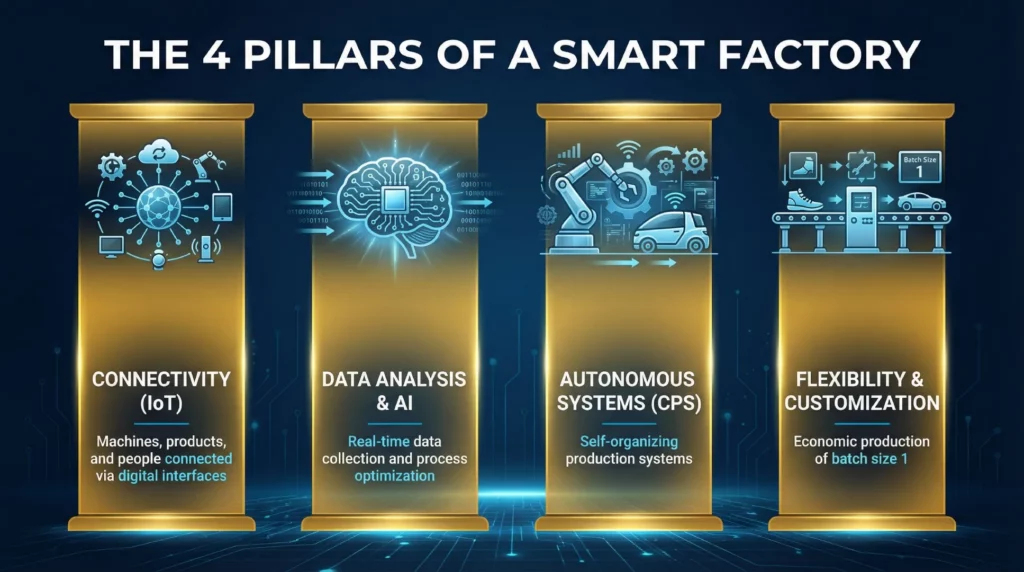
The introduction of a Smart Factory is a strategic investment that creates added value at all levels. Implemented correctly, it leads to a significant Return on Investment (ROI), which is reflected both in short-term efficiency gains and in long-term sustainable competitiveness.
Studies and practical examples impressively demonstrate the potential: companies achieve productivity increases of 10-30%, reduce machine downtime by up to 50%, and significantly reduce energy costs.
The following Smart Factory examples show how leading companies are successfully using digital solutions. In addition to the well-known pioneers, more and more medium-sized companies are also proving that the transformation can succeed on any scale.
The Siemens plant in Amberg is considered an international model. Through fully automated production lines and a Digital Twin for planning, the plant achieves a quality rate of 99.99885%, a nearly error-free production with complete traceability of every component.
Audi shows how a traditional production facility can be transformed through targeted retrofitting. Through the use of 2,500 autonomous robots and data-driven quality control, labor costs in manufacturing were reduced by 30-50%.
As a leading manufacturer of automation technology, Festo shows in its own factory what Industry 4.0 in medium-sized businesses looks like. The production of valves and electronics is modular and highly networked. This enables a high degree of adaptability and serves as a real-world laboratory for customers and partners.
The machine tool manufacturer TRUMPF has converted its own production into a Smart Factory. A central control system networks all machines and processes, from ordering to shipping. The result is a transparent and highly efficient production that serves as a blueprint for the company’s customers.

How quickly does your Smart Factory pay for itself? Find out now in 2 minutes!
With our Clouver ROI Calculator, you can determine how quickly your investment will be amortized. Many of our customers achieve full amortization after just eight months.
A Smart Factory is created through the intelligent interaction of various systems. These technologies form the foundation:
The path to the Smart Factory is a step-by-step process, not a one-time project. A clear roadmap minimizes risks and ensures measurable success.

The implementation presents hurdles. Those who know them can tackle them specifically.
The intelligent factory is constantly evolving. These trends are shaping the future:
The Smart Factory is no longer a theory, but a living reality. The transition to networked, data-driven manufacturing is feasible – even for medium-sized companies. Those who actively shape this change benefit from measurable advantages such as increased productivity, higher quality, and long-term future security.
The crucial question is not if, but how you start. A clearly structured, step-by-step approach, oriented towards your individual goals, is the key to success.
In a non-binding initial consultation, we will analyze together where your company stands and what potential you can unlock.

About the Autor
Tanja is Head of Digital Marketing at ProCom Automation and writes practical articles on CNC, IIoT, Industry 4.0 and efficient manufacturing. The content is developed and technically reviewed in close collaboration with our Clouver IIoT monitoring and CNC experts.
Industry 4.0 is the overarching concept of digital networking. The Smart Factory is its concrete implementation in production.
That depends on the starting position. Initial pilot projects can often be realized in 6–12 months, while the complete transformation usually takes several years.
Automotive, mechanical engineering, electronics, chemicals, and consumer goods – in other words, all industries that require high variant diversity, quality, and efficiency.
Depending on the scope, investments range from a few hundred thousand euros to several million. It is important to view it as a strategic investment with a long-term ROI.



You are currently viewing a placeholder content from Google Maps. To access the actual content, click the button below. Please note that doing so will share data with third-party providers.
More InformationYou are currently viewing a placeholder content from OpenStreetMap. To access the actual content, click the button below. Please note that doing so will share data with third-party providers.
More InformationYou are currently viewing a placeholder content from Facebook. To access the actual content, click the button below. Please note that doing so will share data with third-party providers.
More InformationYou need to load content from reCAPTCHA to submit the form. Please note that doing so will share data with third-party providers.
More InformationYou need to load content from Turnstile to submit the form. Please note that doing so will share data with third-party providers.
More Information