Predictive Maintenance for CNC and Legacy Machines: How to Make Your 20-Year-Old Machine Predictively Maintainable
8. September 2025
It’s Tuesday morning, a major order is running on the machine, and the cutter grinds to a halt. A servo amplifier. Spare part? Discontinued by the original manufacturer. Next available slot for the service technician: a good week away. And the maintenance contract that gets more expensive every year didn’t prevent the failure — because it services by calendar, not by condition.
If this sounds familiar, the obvious reaction is: buy a new machine. But a look around the shop floor tells a different story. The mechanics are fine. Gantry, guides, drivetrain — on high-quality cutting systems, these are built to last 20 to 30 years. What’s missing isn’t steel. It’s information.
And this is exactly where the misunderstanding lies that so often stalls predictive maintenance in practice: most people assume predictive maintenance starts with buying a new, connected machine. That’s wrong. Predictive maintenance is, first and foremost, a data question — and data can be retrofitted.
This guide shows what’s technically required, which retrofit stage fits which machine, when the investment pays off — and when it doesn’t.
AI generated
Key Takeaways at a Glance
Aspect
What you should know about predictive maintenance for legacy machines
Not just for new machines
Wear generates physical signals regardless of build year. What matters is the condition of the mechanics, not the age of the machine.
The cheapest entry point
Current draw. Measurable with a non-invasive current clamp on the control cabinet, with no intervention in the machine controller.
Three retrofit stages
Connect (gateway) → Add sensors → Controller retrofit. Each stage works on its own; starting with a single machine is possible.
The business case
In a Clouver project in metalworking: around 27% less downtime, OEE up from 61% to 78%, payback after nine months.
Where the limits are
For underutilized machines, non-critical auxiliary units, and where maintenance organization is lacking, the effort doesn’t pay off.
Quick definition: What predictive maintenance actually means and how it differs from preventive and condition-based maintenance is explained in our glossary: Predictive Maintenance – Definition.
Does Predictive Maintenance Even Work on Old Machines?
Yes. Even on systems without any digital interface, even on machines from the early 2000s, even from manufacturers that no longer exist.
The reason is simple: wear generates physical signals long before it leads to failure. A bearing that’s failing first gets warmer, then louder, then rougher. A knife drive that’s becoming stiff draws more current. An axis developing play takes longer to reach its target position. These signals are there – regardless of build year. The only question is whether anyone is recording them.
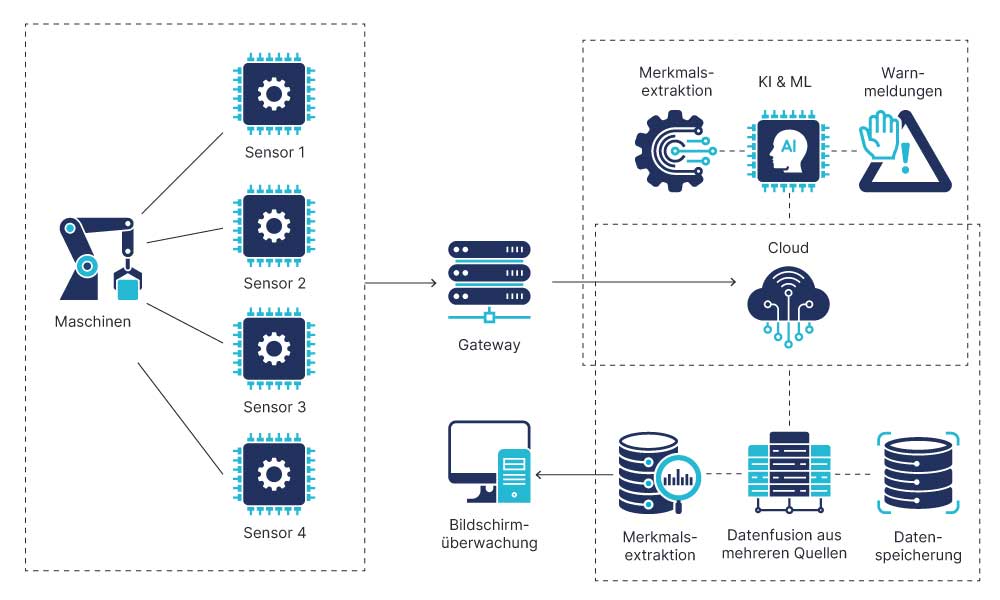
On a new machine, the controller delivers these values via an open interface. On a legacy machine, you get them through retrofitted sensors, an IoT gateway on the controller – or, if you’re modernizing anyway, through a new controller.
What Data Your Legacy Machine Delivers – And What It Reveals
Not every measurement is equally valuable. For cutting systems and CNC machining equipment, four data sources have proven especially informative:
Data source
What it reveals about condition
How it can be retrofitted
Current draw
Rising power demand at drives, knives, spindles. The cheapest early indicator of mechanical wear there is.
Non-invasive current clamp on the control cabinet – no intervention in the machine controller.
Vibration
Bearing damage, imbalance, guide wear, loose fasteners. Often shows up weeks before failure.
Adhesive or bolted accelerometers at bearing points.
Temperature
Friction, coolant shortage, thermal overload on drives and amplifiers.
Contact or infrared sensors, often already present and simply not being read out.
Controller and axis data
Position deviations, settling times, tracking errors, fault message history. The most informative source – and the one that requires access to the controller.
Read out via the controller interface or through a controller retrofit.
The practical starting point is almost always current draw. A current clamp, a gateway, no intervention in the machine – and within a few weeks a normal profile emerges, against which every deviation can be measured.
Important for setting expectations: up to this point you’re running condition monitoring – you can see that something is off. It only becomes a forecast once enough history is available to infer the time of failure from the trend. This sequence can’t be skipped.
The Three Retrofit Stages: What Fits Your Machine?
Retrofitting predictive maintenance isn’t an all-or-nothing decision. In practice, there are three stages that build on one another – and most projects start at stage 1.
Stage 1: Connect
Stage 2: Add sensors
Stage 3: Controller retrofit
What happens
IoT gateway on the control cabinet, current draw and status signals are captured
Additional vibration and temperature sensors on critical components
New CNC controller, full data access to all axes and process values
Intervention in the machine
none
minimal
significant
Effort per machine
typically under an hour
a few hours
a project spanning several days
What you can do afterward
Capture every downtime event, recognize patterns, measure OEE
Predict wear on defined components
Full process monitoring, quality data, more precise forecasts
Additional effect
Transparency across the entire machine fleet
Targeted maintenance planning
Precision and cutting speed increase too, securing the investment for another 10 to 15 years
When it makes sense
Always as a starting point. Also to find out where stages 2 and 3 pay off.
For known weak points and expensive bottleneck machines
When the controller is outdated anyway, spare parts are unavailable, or vendor dependency needs to be resolved
Stage 3 in Detail: Why a Retrofit Fundamentally Changes Your Data
At stages 1 and 2, you measure on the machine. At stage 3, you read from the machine.
A controller retrofit – at ProCom Automation using the ProCom CNC300 – replaces the outdated controller with an open, industrial-PC-based system. After that, axis positions, servo currents, tracking errors, cycle times, and fault messages are all available as digital signals. That’s the difference between “the machine is drawing more current somewhere” and a concrete statement like: axis Y has measurably taken longer to reach its target position for three weeks.
A side effect that often carries the business case: the retrofit doesn’t just improve the data – it improves the machine itself. Technologies like SmartKnife handle tangential knife alignment in real time, while ModernBlendTime smooths movement through corner points instead of braking.
“In the past, it often wasn’t the machine’s mechanics that were the limiting factor, but the controller – it simply couldn’t calculate and drive the knife fast enough. With modern algorithms like ModernBlendTime, we significantly raise the limits on cutting speed – a genuine productivity gain for the existing machine.”
The Business Case: What Downtime Costs, What Retrofitting Costs
The honest answer to “what’s the benefit?” is: it depends on how expensive an hour of downtime is on your shop floor. Work it out once – machine hourly rate plus the contribution margin of the lost orders plus the labor cost of the waiting shift. The number surprises most people.
Set against that are the documented effects. From a Clouver project in metalworking:
around 27% less downtime within one year
OEE increased from 61% to 78%
payback after nine months – the savings exceeded the investment costs
Where the Costs Actually Show Up
This table doesn’t compare the definitions of maintenance strategies – it compares just one thing: where your money ends up under each strategy.
Cost item
Reactive
Preventive (calendar-based)
Predictive
Unplanned downtime
maximal – at the worst possible times
reduced, but not eliminated
minimal
Spare parts procurement
emergency purchases at top prices, rush surcharges
high capital tied up in stock
demand-driven, plannable
Parts replaced
only failed ones
also intact ones – routinely too early
mostly only the necessary ones
Maintenance staffing
firefighting mode, overtime
fixed schedule, sometimes without cause
controllable by priority
On-time delivery to customers
at risk
partially at risk
reliable
The expensive blind spot of preventive maintenance: it replaces parts that still work and still misses the failures that occur between intervals. So you pay twice – for parts that were still good, and for downtime that happened anyway.
To see how these effects translate into your Overall Equipment Effectiveness (OEE), check out our page on OEE optimization, including an ROI calculator.
See it with your own numbers. In 30 minutes, our IIoT experts will show you the Clouver platform, analyze your production situation, and sketch out initial implementation ideas – no obligation.
Step 1: Start With Your Bottleneck Machine, Not the Whole Fleet
The most common mistake is trying to connect everything at once. That turns into an IT project, takes months, and delivers no results for a long time.
Instead, pick the one machine whose downtime hurts the most. A gateway, current draw, status signals. Within a few weeks, you’ll have a reliable normal profile – and usually the first uncomfortable realization of just how much downtime actually occurs and where it comes from. In our experience, that insight is what funds the next step.
Step 2: Recognize Patterns Before You Build Models
Before any algorithm can calculate forecasts, it needs a reference for “normal.” This phase can’t be shortcut – a forecasting model without a baseline produces false alarms, and nothing kills acceptance among maintenance staff faster than three false alarms in the first week.
More important than technology here is the maintenance team. Your colleagues know which machine “sounds off before something happens.” That knowledge is your model’s foundation. Bring it in early.
Step 3: Scale by Impact, Not by Completeness
Only once stage 1 shows results on one machine do you move on – either broadening (connecting more machines) or deepening (adding sensors, renewing the controller). The data should make this decision, not gut feeling.
Because Clouver is vendor-independent and has no age limit, you can run both in parallel: an older plasma cutting system and a modern CNC laser show up in the same dashboard. Learn more: Clouver IIoT Monitoring.
When Predictive Maintenance Isn’t Worth It
This belongs in any honest assessment – and it’s the section most vendors leave out.
Predictive maintenance generally doesnot pay off for:
Machines with low utilization. If a system only runs a fraction of the time, downtime can usually be scheduled without any production loss.
Non-critical auxiliary units with cheap, readily available spare parts. A bearing costing a few euros that takes an hour to replace doesn’t need a forecast.
Machines nearing decommissioning. If it’s being replaced in a year and a half, nothing will pay off anymore.
A lacking maintenance organization. If no one can respond to a warning because staffing doesn’t allow it, the system only creates frustration. Predictive maintenance doesn’t replace maintenance – it makes it plannable.
Mechanically worn-out machines. A retrofit modernizes the controller and drives. It won’t fix worn-out guides or a warped gantry.
The reverse is the filter you need: predictive maintenance pays off where a well-utilized machine with sound mechanics is being held back by an outdated controller – and where a maintenance team is ready to act on warnings.
Frequently Asked Questions
Can predictive maintenance be retrofitted on machines without a digital interface?
Yes. Non-invasive sensors such as current clamps and IoT gateways can capture operating conditions even without a machine interface. No intervention in the machine controller is required. For deeper process data such as axis positions or tracking errors, access to the controller is needed – that’s where a controller retrofit comes in.
How old can a machine be for predictive maintenance?
There is no age limit. What matters is the condition of the mechanics, not the build year. On high-quality cutting systems, the mechanics are designed to last 20 to 30 years; a controller retrofit secures the investment for another 10 to 15 years. The connection works independently of manufacturer and without age restrictions – even on machines whose original manufacturer no longer provides support.
What does a predictive maintenance retrofit cost?
Costs depend on the retrofit stage: from a single IoT gateway to a complete controller retrofit with drive technology. Because every stage can be implemented on its own, it’s possible to start with one machine and a manageable budget. For a reliable calculation, we need the machine type, utilization, and the cost of an hour of downtime at your facility.
How long does it take to connect a legacy machine?
Connecting a single machine via an IoT gateway typically takes less than an hour. The first usable insights into downtime patterns are available after a few days to weeks, once a normal profile has been established.
Does production data have to go to the cloud?
No. Clouver can be run either as a cloud solution or entirely on-premises. In cloud operation, sensor data is pre-filtered directly at the machine when needed (edge computing) and stored in certified German data centers – GDPR-compliant, with granular permission management controlling who sees which data. If your IT policies don’t allow the cloud, a pure on-premises setup is possible.
Can predictive maintenance be connected to our ERP system?
Yes. The connection is made via open interfaces; if your ERP system can export via MQTT, the connection works without extra effort. Otherwise, an interface is established via a gateway. This way, maintenance alerts flow into production planning and machine data flows back into the ERP.
Conclusion
Predictive maintenance isn’t a privilege reserved for new machines. Anyone running a mechanically sound system with an outdated controller often has better odds than a facility with a heterogeneous fleet of half-connected new machines – because the path is clear: capture data, recognize patterns, retrofit strategically.
The starting point is smaller than most people expect. One machine, one gateway, a few weeks of observation. What follows from that is decided by the data.
ProCom Automation has been developing control technology for cutting systems for over 40 years, and with Clouver connects legacy machines – regardless of manufacturer – into a single IIoT platform, from older plasma cutting systems to current CNC lasers.
Is predictive maintenance worth it for your machine? Send us the machine type, build year, and controller – we’ll tell you which retrofit stage is realistic and where the biggest lever is. → Request retrofit consulting
Tanja Thelen
About the Author
Tanja heads Digital Marketing at ProCom Automation and writes practice-oriented articles on CNC, IIoT, Industry 4.0, and efficient manufacturing. The content is developed in close collaboration with our Clouver IIoT monitoring and CNC experts and is reviewed for technical accuracy.
Introduction Overall Equipment Effectiveness (OEE) is one of the most important metrics in manufacturing. It combines availability, performance and quality…
The Smart Factory is the heart of modern industrial manufacturing: a highly networked, self-organizing production environment in which people, machines,…
You are leaving this website and will be redirected to an external site
You are currently viewing a placeholder content from Google Maps. To access the actual content, click the button below. Please note that doing so will share data with third-party providers.
You are currently viewing a placeholder content from OpenStreetMap. To access the actual content, click the button below. Please note that doing so will share data with third-party providers.
You are currently viewing a placeholder content from Facebook. To access the actual content, click the button below. Please note that doing so will share data with third-party providers.