Industrial Retrofits: The Practical Guide to Modernising Your Machinery
13. March 2026
Your tried-and-tested machine is the heart of your production – mechanically robust, but technologically outdated. You are faced with a…

10. October 2025
CNC machines are the backbone of modern industry. They combine accuracy, efficiency and automation, enabling manufacturing processes that would have been unthinkable just a few decades ago.
This practical guide explains how CNC technology works, the different types of machines available, the role of digitalisation – and why investing in CNC systems pays off, especially for medium-sized companies.
CNC stands for Computerised Numerical Control.
A CNC machine uses digitally transmitted commands to machine workpieces with extreme precision. Unlike conventional machines, it operates automatically based on so-called G-codes, which define every movement, cut and tool action.
This technology forms the foundation of numerous manufacturing processes – from milling and drilling to cutting and engraving. CNC machines are therefore indispensable in sectors such as mechanical engineering, automotive production, medical technology, and aerospace.
The manufacturing process begins with a digital 3D model created in a CAD system (Computer-Aided Design).
This model is transferred to a CAM system (Computer-Aided Manufacturing), where the programmer defines tool paths, tools, and cutting parameters. The CAM software then generates the G-code, which contains all movement instructions for the machine.
Common commands include:
These codes control movement along the X, Y and Z axes, determining exactly where and how the tool engages the workpiece.
A simple programme might look like this:
G00 X0 Y0 Z0
G01 X10 Y10 Z-5 F150
G02 X20 Y20 I10 J10
M30
The control system translates these coordinates into highly precise machine movements – achieving repeatable accuracies in the micrometre range.
While traditional machines require manual operation, CNC machines run almost entirely automatically.
The difference becomes clear in several areas:
| Aspect | Conventional Machining | CNC Machining |
|---|---|---|
| Operation | Manual | Computer-controlled |
| Accuracy | Operator-dependent | Micrometre-precise |
| Repeatability | Inconsistent | Constant |
| Set-up times | Long | Short through digital programmes |
| Flexibility | Limited | Highly adaptable |
Advantages for manufacturers:
Especially for companies with variable batch sizes, CNC technology offers major benefits – processes can be adjusted within minutes without mechanical retooling.
CNC machines differ primarily in the number of axes – that is, the directions in which they can move.
The classic version works along the X, Y and Z axes and is suitable for standard operations such as milling and drilling.
Example: flat machining of aluminium plates or drilling hole patterns.
In addition to linear motion, a rotary axis (A) is added. This allows machining of multiple sides of a part in a single clamping operation – for example, shafts or cylindrical components.
High-end systems feature two rotary axes (A and B) and can machine almost any contour.
They are commonly used in aerospace and toolmaking, where complex free-form surfaces are required.
| Type | Axes | Typical Application |
|---|---|---|
| 3-Axis CNC | X, Y, Z | Milling and drilling of simple parts |
| 4-Axis CNC | X, Y, Z, A | Rotational machining |
| 5-Axis CNC | X, Y, Z, A, B | Complex contours and free-form surfaces |
Programming is the heart of CNC technology.
Whereas G-codes once had to be written manually, modern CAM systems now generate them automatically from 3D models – saving time and eliminating potential errors.
Advantages of automated programming:
Discover our software solution ergoCNC –
the intelligent control system for contour cutting machines.
CNC technology is universally applicable – across nearly every industrial sector.
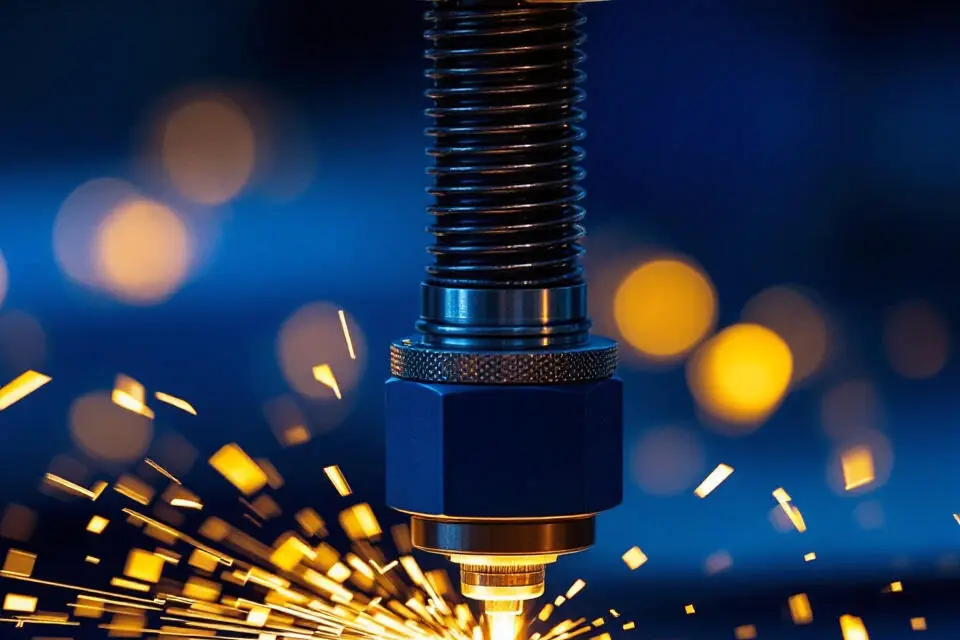
Modern machine tools with computer-controlled systems enable ultra-precise processes such as milling, drilling and engraving, even for extremely filigree structures. Thanks to advanced control technology, workpieces made from various materials – from soft plastics to tough stainless steel or high-strength titanium – can be machined with reproducible accuracy. The precise rotation of the tools and the controlled axis movements ensure uniform surfaces, minimal tolerances, and efficient production cycles. Whether in prototyping, series production or the finishing of complex components – CNC machines form the foundation of today’s automated manufacturing chains.
CNC machines process hard materials with the highest level of accuracy.
In plastics processing, CNC milling machines are used to produce injection moulds or complex housings.
In furniture and interior design, CNC machining centres enable precise milling, engraving and serial production with minimal waste.
In medical technology, CNC machines manufacture implants, screws and surgical instruments.
In aerospace, they are used for housings or structural elements with complex geometries.
A high-performance, automated production machine is much more than a tool – it is a strategic investment in efficiency, quality and competitiveness. Through its computer-controlled operation, it ensures consistent machining accuracy even for complex or delicate components. Companies benefit not only from improved process reliability but also from better planning and more efficient resource use. Especially in medium-sized enterprises, the targeted use of CNC technology significantly reduces production costs and cycle times – a decisive factor for long-term profitability.
Cost Structure
Practical example:
A supplier in North Rhine-Westphalia invested in two new 5-axis machining centres. Thanks to automated multi-side machining, production time per part fell from 45 to 28 minutes. The return on investment was achieved after just 2.8 years.
Learn more:
“How Clouver boosts efficiency and transparency through data-driven analysis.”
Digital transformation has fully reached the manufacturing sector.
CNC machines are increasingly becoming part of an interconnected production ecosystem. The networking of CNC machines can be further optimized through digital manufacturing with RFID integration, among other things, so that workpieces and orders are automatically recognized.
With Industrial Internet of Things (IIoT) solutions such as Clouver – Data-Driven Intelligence for the Future of Industry 5.0 – machine statuses, energy consumption and OEE values can be recorded in real time. This creates transparency about where efficiency reserves exist and how processes can be optimised.
For more information, see the article:
“IIoT Devices: How to Digitalise Your Industrial Production.”
A digital twin is a virtual replica of a machine or production line.
It enables simulation and optimisation before a process is implemented physically – ideal for minimising risks and material waste.
Through sensor data and algorithms, companies can detect wear or deviations at an early stage. This makes maintenance predictable – downtime is reduced by up to 25%.
The future of CNC technology lies in the combination of robotics, AI and data analytics.
This combination creates manufacturing solutions that operate almost autonomously – efficient, transparent and error-resistant.
CNC technology makes a key contribution to sustainable industrial production:
CNC technology therefore embodies the philosophy of Industry 5.0 – efficient, data-driven and environmentally responsible manufacturing.
CNC machines are far more than tools – they are the heart of modern manufacturing.
They combine accuracy with automation, reduce error rates and increase efficiency across every stage of production. By integrating CNC systems into Industry 4.0 and IIoT environments, companies unlock new potential for growth, quality and sustainability. Investing in CNC technology today lays the foundation for tomorrow’s production – digital, efficient and future-ready.

About the Autor
Tanja is Head of Digital Marketing at ProCom Automation and writes practical articles on CNC, IIoT, Industry 4.0 and efficient manufacturing. The content is developed and technically reviewed in close collaboration with our Clouver IIoT monitoring and CNC experts.
A milling machine performs one working process, while a machining centre combines several processes – e.g. milling, drilling and thread cutting.
Tool condition, machine rigidity, thermal stability and precise axis movements. High-quality controls automatically compensate for temperature drifts.
Through intelligent speed control, optimised axis movements, standby modes and data-based evaluations via an IIoT platform (e.g. Clouver).
Stable power supply, climate-controlled area, low-vibration foundation and sufficient space for magazine, peripherals or robotics. A suitable IT infrastructure is also important.
For complex contours, multi-side machining and high accuracy requirements. Particularly valuable in toolmaking, aerospace and medical technology.
Tool selection depends on the material, cutting parameters and the desired surface quality. Decisive factors include tool material, coating and cutting edge geometry.
A CNC machine should only be operated with closed protective enclosures, functioning door monitoring and personal protective equipment. Interventions in the working area may only be carried out when the machine is at a standstill.



You are currently viewing a placeholder content from Google Maps. To access the actual content, click the button below. Please note that doing so will share data with third-party providers.
More InformationYou are currently viewing a placeholder content from OpenStreetMap. To access the actual content, click the button below. Please note that doing so will share data with third-party providers.
More InformationYou are currently viewing a placeholder content from Facebook. To access the actual content, click the button below. Please note that doing so will share data with third-party providers.
More InformationYou need to load content from reCAPTCHA to submit the form. Please note that doing so will share data with third-party providers.
More InformationYou need to load content from Turnstile to submit the form. Please note that doing so will share data with third-party providers.
More Information