Smart Factory examples: What you can learn from five German pioneers
17. December 2025
Productivity increases of over 25%, plant availability of 95% and a dramatic reduction in rework of 85% – these are…


14. February 2025
IIoT protocols form the backbone of modern industrial communication. In this comprehensive guide, you will learn which protocols are suitable for your applications and how to implement them securely. Benefit from proven practical tips for integrating OPC UA, MQTT and other standards.
The Industrial Internet of Things (IIoT) enables the networking of intelligent machines, advanced analytics and human labour. By integrating machines and devices via the Internet, you can collect and exchange comprehensive data in real time. This data provides you with deeper insights into production processes, improves automation and optimises operations. IIoT increases productivity, reduces costs and opens up new business models.
Communication protocols are essential for data exchange between IIoT devices. They define the rules and formats for data transmission and ensure that information is transferred reliably and securely between different systems. Protocols such as OPC UA and MQTT enable interoperability between machines, sensors and control systems while ensuring high data security and efficiency.
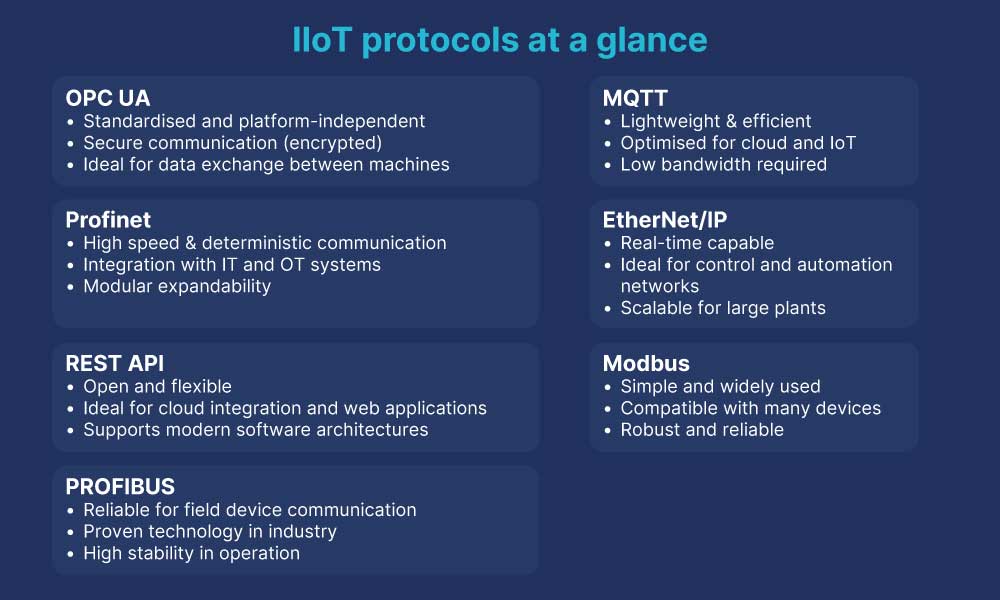
Commonly used IIoT protocols include:
Architecture and Functionality
OPC UA is a flexible, platform-independent communication protocol that enables secure and reliable data transmission. It supports various transport protocols such as TCP and HTTP and facilitates interoperability between devices from different manufacturers through uniform data models.
Key Features and Advantages
Use Cases
OPC UA is widely used in manufacturing to connect machines and control systems and exchange data in real time. Typical applications include monitoring production processes, plant control and management, and integration of SCADA systems.
Architecture and Functionality
MQTT is a lightweight protocol specifically designed for message transmission in networks with low bandwidth and high latency. It is based on a publish/subscribe model in which a broker handles message distribution.
Key Features and Advantages
Use Cases
MQTT is often used in remote monitoring and control of IoT devices, such as in smart homes, smart grids and industrial control systems.
Each protocol has specific strengths and is suitable for different applications. The choice of the right protocol depends on your individual requirements, including factors such as bandwidth, latency, security requirements and resource efficiency.
Secure your production processes with Clouver!
Discover how our IIoT platform reveals untapped potential and sustainably increases your efficiency.
Secure communication is essential to ensure the integrity and confidentiality of data. Cybersecurity requirements include protection against unauthorised access, ensuring data integrity and protection against cyberattacks. You must implement robust security strategies to protect your IIoT systems.
TLS/SSL encryption protects data during transmission. A certificate manager such as Let’s Encrypt ensures the authenticity of communication partners and automates the management of certificates.
OAuth2.0 enables secure authentication in IIoT environments, ensuring that only authorised devices and users can access the data.
Segmenting the network can minimise security risks. Access controls such as firewalls and intrusion detection systems prevent unauthorised access and increase network security.
The integration and interoperability of Industrial IoT systems are based on several key components:
These interlocking aspects form the foundation of a future-proof IIoT infrastructure that efficiently connects both existing and new systems.
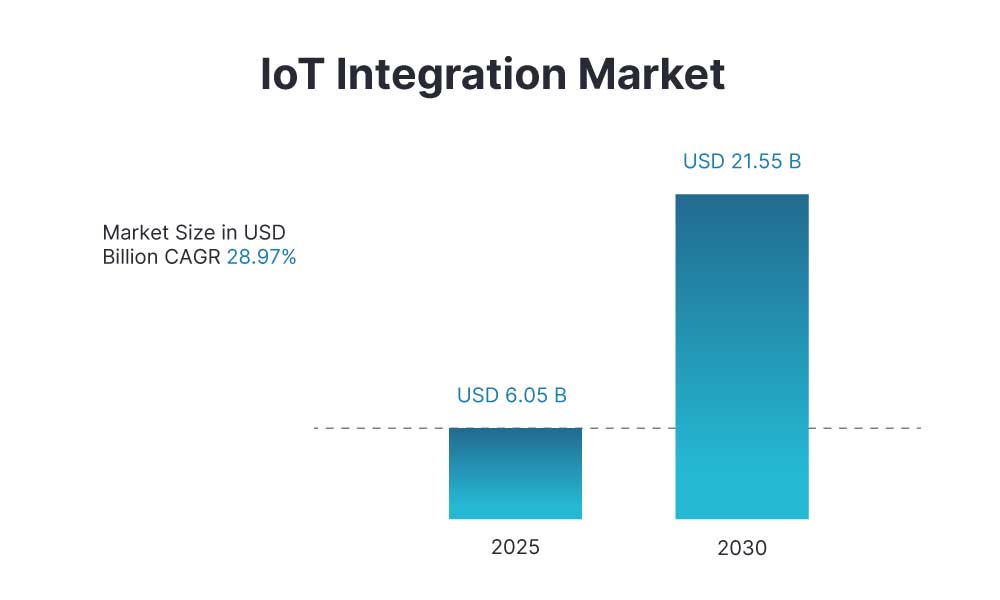
Current market developments also show that the integration of industrial IoT systems is becoming increasingly important worldwide. According to a study by Mordor Intelligence, the global market for IoT integration services is expected to grow from USD 6.05 billion (2025) to USD 21.55 billion in 2030 – an annual growth rate of almost 29%. (Source: Mordor Intelligence, IoT Integration Market Report 2025)
Example projects and SDKs support the development of IIoT solutions and help you quickly start implementing protocols.
Use test and validation software such as the OPC UA Compliance Test Tool and MQTT.fx to verify the conformity and performance of the implemented protocols.
The choice and implementation of the right IIoT protocols largely determine the success of your digital transformation. With Clouver, you can make optimal use of the advantages of various protocols. The IIoT platform supports all common standards such as OPC UA and MQTT and enables flexible, manufacturer-independent integration of your systems. The data collected via these protocols is crucial for advanced analytics, including OEE Optimisation and predictive maintenance.
By combining proven protocols with a powerful IIoT platform such as Clouver, you benefit from:
Read also our Clouver Brochure –
your IIoT solution for greater transparency and efficiency in production

About the Autor
Tanja is Head of Digital Marketing at ProCom Automation and writes practical articles on CNC, IIoT, Industry 4.0 and efficient manufacturing. The content is developed and technically reviewed in close collaboration with our Clouver IIoT monitoring and CNC experts.


You are currently viewing a placeholder content from Google Maps. To access the actual content, click the button below. Please note that doing so will share data with third-party providers.
More InformationYou are currently viewing a placeholder content from OpenStreetMap. To access the actual content, click the button below. Please note that doing so will share data with third-party providers.
More InformationYou are currently viewing a placeholder content from Facebook. To access the actual content, click the button below. Please note that doing so will share data with third-party providers.
More InformationYou need to load content from reCAPTCHA to submit the form. Please note that doing so will share data with third-party providers.
More InformationYou need to load content from Turnstile to submit the form. Please note that doing so will share data with third-party providers.
More Information