IIoT Protocols Explained: How to Optimise Your Industrial Production
14. February 2025
IIoT protocols form the backbone of modern industrial communication. In this comprehensive guide, you will learn which protocols are suitable…


13. March 2026
Your tried-and-tested machine is the heart of your production – mechanically robust, but technologically outdated. You are faced with a decision familiar to many manufacturing companies: continue operating it and accept growing risks, replace it at great expense, or modernise it intelligently?
This guide, based on over 40 years of practical experience in CNC control technology, provides you with a sound and honest basis for your decision. We explain what retrofit really means, highlight the key drivers from real-world experience and outline the various stages of modernisation.
| Aspect | What you need to know |
|---|---|
| The real drivers | Often, it is not performance improvements but IT security and a lack of spare parts that make a retrofit unavoidable. |
| Cost-effectiveness | A retrofit makes particular sense if the mechanical condition of your machine is good and a new purchase would be expensive. |
| The three stages | From a simple PC upgrade through a control system retrofit to a complete modernisation, there is a suitable approach for every situation. |
| Real risks | Lack of documentation, safety standards and the human factor are the most common challenges – and they can be overcome with good preparation. |
The term retrofit describes the targeted technological conversion of existing machines and systems. Essentially, it is not about preserving the old, but making tried-and-tested systems fit for the future through targeted innovations.
Unlike a simple repair (restoring the original function) or overhaul (replacing worn parts), a retrofit is a far-reaching technological upgrade. The focus is on renewing the machine’s ‘intelligence’ – i.e. the control system, drives and software – whilst the solid mechanical framework is retained and continues to be used.
From practice: “The key factor in ensuring a retrofit is worthwhile is the mechanical engineering. The mechanical framework must be of high quality and durable. Then it is also worth investing in modernising the control technology.” — Harald Müller – Team Lead Delivery
Here is an important insight from our many years of experience: Higher productivity is a welcome side effect, but rarely the actual trigger for a retrofit project. The real drivers are often of a more pragmatic and urgent nature.
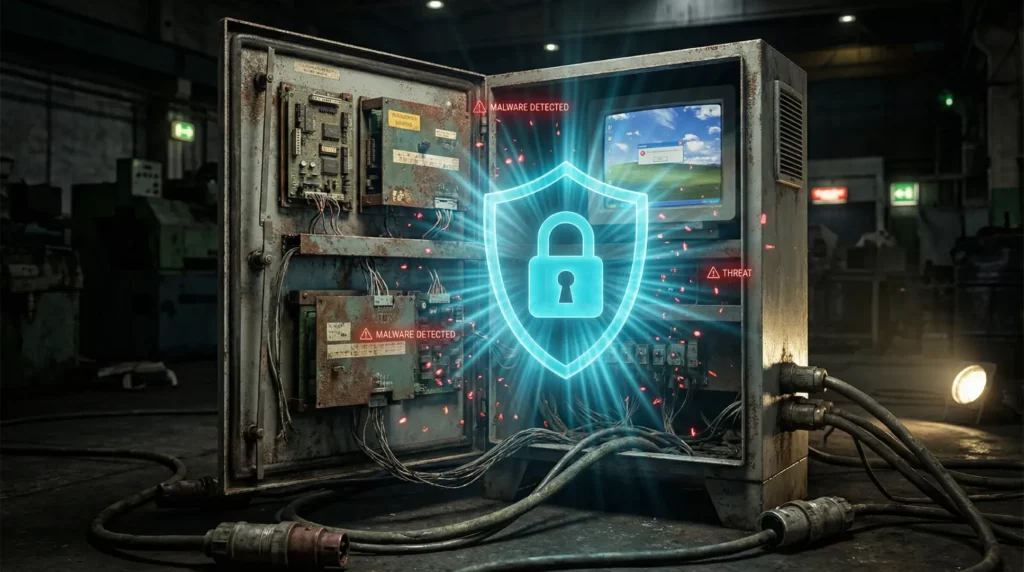
The most common reason for an upgrade is an outdated operating system. Machines running on Windows XP, Windows 7 or, soon, Windows 10 no longer receive security updates from Microsoft. They are an open gateway for malware and pose an incalculable risk to your entire corporate network. In many companies today, it is the IT department that is pushing for modernisation for security reasons – and rightly so.
Electronic components age. After 15 to 20 years in operation, the risk of failure increases significantly. At some point, the stage is reached where spare parts are no longer available for old control technology – neither from the manufacturer nor on the open market. A failure of the CPU or a motherboard controller then means a complete standstill. In this situation, a retrofit is the only cost-effective alternative to scrapping an otherwise fully functional machine. See how you can further safeguard against the failure risk of ageing machinery in our article on Maintenance & Updates.
From real-world experience: “Sometimes it’s like an old car. Something’s always breaking down and every time it’s pay, pay, pay. Eventually you say: I’ve had enough, get rid of it or fit a new engine. A retrofit is the ‘new engine’ for your machine.” — Harald Müller – Team Lead Delivery
Do you operate a high-layer, single-layer or contour cutter with a ProCom control system? If so, having a spare control system to hand could be crucial for your production reliability. If the control system fails, replacement systems are often not available at short notice. By making provisions at an early stage, you can reduce downtime and remain operational in the event of an emergency.
Talk to your machine manufacturer now about a ProCom spare control system as a stock item.
A retrofit is an investment that has to pay off – and in the right cases, it pays off very well. It is the economically sensible choice if the mechanical components of your machine are of high quality and durable, if a comparable new machine would be very expensive, or if it is a specialised machine that is no longer available on the market. In these scenarios, the cost of a retrofit is often only a fraction of the cost of a new purchase, with significantly shorter downtimes.
Modern motion algorithms, such as the ‘Modern Blend Time’ method used by ProCom, enable cutting contours to be traversed more smoothly and quickly. In practice, this typically results in productivity gains of 4 to 6 per cent whilst maintaining the same quality – provided the machine’s mechanics allow it. Even though this is often not the main reason for a retrofit, this effect represents a clearly measurable added benefit.
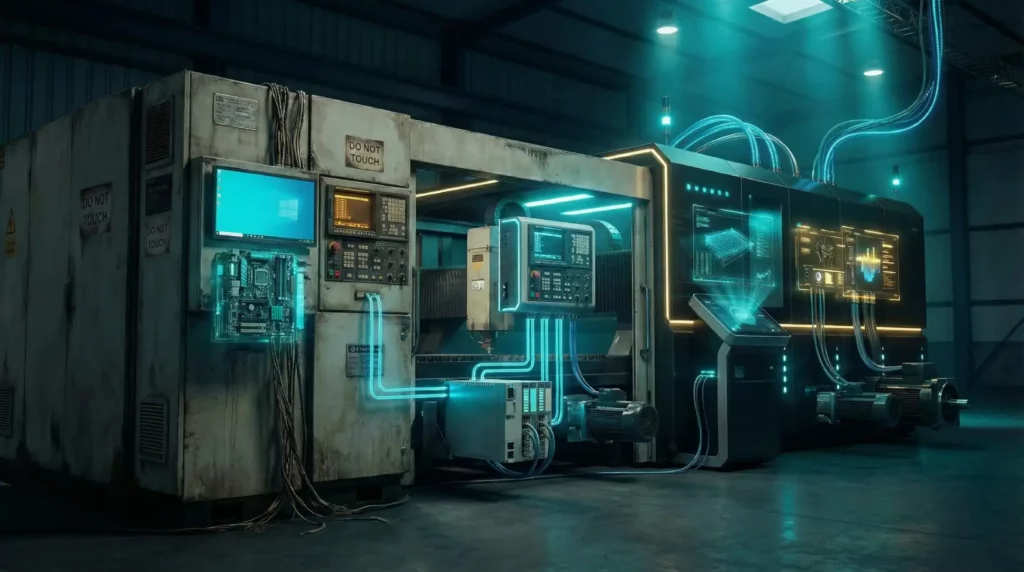
Not every retrofit is the same. Depending on the age, condition and objectives of the machine, there are three sensible stages of escalation.
| Stage | Description | What is replaced? | Typical objective |
|---|---|---|---|
| 1 | PC upgrades | PC core (motherboard, CPU, memory, hard drive) | IT security, operating system update |
| 2 | Control system retrofit | Complete control system + interface modules | Long-term operational reliability, IIoT capability |
| 3 | Complete modernisation | Control system + entire drive technology | Maximum performance, condition equivalent to a new machine |
This is the simplest form of modernisation. Here, only the PC core of the old software and hardware – i.e. the motherboard, CPU, memory and hard drive – is replaced by a modern, Windows 11-compatible platform. The actual control electronics and the interface to the drive technology remain in place. This solution is quick to implement and primarily restores IT security.
This is the most common and often the most cost-effective approach. The entire old control unit is replaced by a modern, EtherCAT-based system such as the ProCom CNC300. However, the proven drive technology (motors, controllers, cables) within the machine remains in place. Intelligent converter modules ensure communication between the new digital control system and the old analogue drive system. The result: a machine with modern ‘intelligence’ and minimal on-site conversion effort.
This is the most comprehensive, but also the most complex option. Here, both the control system and the entire drive technology (including motors, cables and controllers) are replaced with state-of-the-art components. Only the machine’s pure mechanics remain unchanged. This option achieves the greatest increase in performance and energy efficiency, but requires extensive mechanical and electrical conversion on site and is consequently more costly.

Efficiency in the retrofit process is crucial to minimising downtime for the end customer. An approach developed by one of our mechanical engineering partners and perfected through numerous projects demonstrates how it’s done:
The idea: Instead of carrying out complex cabling on-site at the customer’s premises, the entire conversion is prepared in the workshop. The new, compact ProCom solution is mounted in a special housing together with the necessary level converters. This housing has exactly the same dimensions and – even more importantly – exactly the same connectors on the rear as the old, significantly larger control system. The on-site conversion is thus reduced to a simple swap: out with the old technology, in with the new retrofit box, plug it in. This minimises sources of error, makes the process reproducible and significantly reduces machine downtime at the customer’s site.
A retrofit project is not a sure-fire success. Based on our experience from many joint projects, these are the most common challenges for which one must be prepared:
Incomplete documentation: What exactly was delivered with the machine 15 years ago? Which special functions were programmed and may have long since been forgotten? A careful analysis of the existing documentation and the current software version in advance is crucial to avoid missing functions after the retrofit and having to rectify them under time pressure.
Machine safety and CE conformity: A retrofit may be legally classified as a ‘substantial modification’ of the machine. This means that, following the retrofit, the machine must comply with the currently applicable safety standards (in particular the Machinery Directive 2006/42/EC). This must be carefully assessed in advance by competent technical experts to avoid unexpected costs for additional safety devices.
The human factor: The new user interface is more modern and intuitive, but it is different from what users are accustomed to. Structured training for operators is crucial for acceptance and the rapid, safe resumption of production.
A collaborative approach, in which all these points are openly communicated and planned together, is the key to success.

Retrofitting is a sensible option in almost all areas of mechanical and plant engineering. ProCom’s core expertise lies in the field of cutting and machining systems.
What is the difference between a retrofit and a repair?
A repair restores the original function of a faulty component – without any technological improvement. A retrofit is a comprehensive technological upgrade: the control systems and, where applicable, drive technology are replaced by modern systems, which significantly improves the machine’s performance, safety and future-proofing.
For which machines is a retrofit worthwhile?
A retrofit is particularly worthwhile for high-quality machines with robust mechanics, where a new purchase would be very expensive, or for specialised machines that are no longer available on the market. For inexpensive standard machines, a new purchase may make more economic sense – honest advice will help you make the right decision.
How long does a retrofit project take?
The duration depends heavily on the scope of the retrofit. The actual downtime of the machine at the customer’s site can be significantly reduced through good preparation (e.g. the ‘Retrofit Box’ concept). For a pure control system retrofit, well-prepared projects are often completed in just a few days. A complete modernisation involving drive technology requires more time. We would be happy to discuss specific timelines with you individually.
Which components are most frequently replaced?
The focus is almost always on the CNC control system and drive technology, as these are the ‘intelligent’ components and therefore the most susceptible to ageing. Mechanical parts such as the machine frame or guides are generally retained. Individual sensors and control cabinet components are also replaced as required.
Does a new CE marking need to be issued following a retrofit?
This depends on the scope of the retrofit. A retrofit may be classified as a “substantial modification” within the meaning of the Machinery Directive, which requires a new conformity assessment and CE marking. This must be assessed in advance by a technical expert. We can advise you on this and work with relevant partners.

A retrofit is far more than just a repair. It is the strategically wise decision to preserve the proven assets of your production and equip them with today’s intelligence, safety and connectivity. It safeguards your production capacity, minimises risks and sets the course for an economical and sustainable future.
With a partner who has been at home in CNC control technology for over 40 years, you won’t be walking this path alone.
As specialists in the retrofitting of textile cutting machines, we know exactly what matters. Get in touch – we’ll analyse your situation and work with you to find the right modernisation strategy.

About the author
Annika is a Digital Marketing Manager at ProCom Automation and writes practical, hands-on articles on CNC, IIoT, Industry 4.0 and efficient manufacturing. The content is developed in close collaboration with our Clouver IIoT Monitoring and CNC experts and is technically reviewed.


You are currently viewing a placeholder content from Google Maps. To access the actual content, click the button below. Please note that doing so will share data with third-party providers.
More InformationYou are currently viewing a placeholder content from OpenStreetMap. To access the actual content, click the button below. Please note that doing so will share data with third-party providers.
More InformationYou are currently viewing a placeholder content from Facebook. To access the actual content, click the button below. Please note that doing so will share data with third-party providers.
More InformationYou need to load content from reCAPTCHA to submit the form. Please note that doing so will share data with third-party providers.
More InformationYou need to load content from Turnstile to submit the form. Please note that doing so will share data with third-party providers.
More Information