IoT Device Monitoring: How to Keep an Eye on Your Production with Clouver!
12. May 2025
Do you want to know how well your machines are really performing? Are you looking for a way to detect…

17. December 2025
Productivity increases of over 25%, plant availability of 95% and a dramatic reduction in rework of 85% – these are not theoretical scenarios, but the measurable results achieved by German companies that have already successfully made the transition to the smart factory. The transformation to the smart factory is the decisive lever for remaining competitive in the global marketplace. But how can this complex change be achieved in practice?
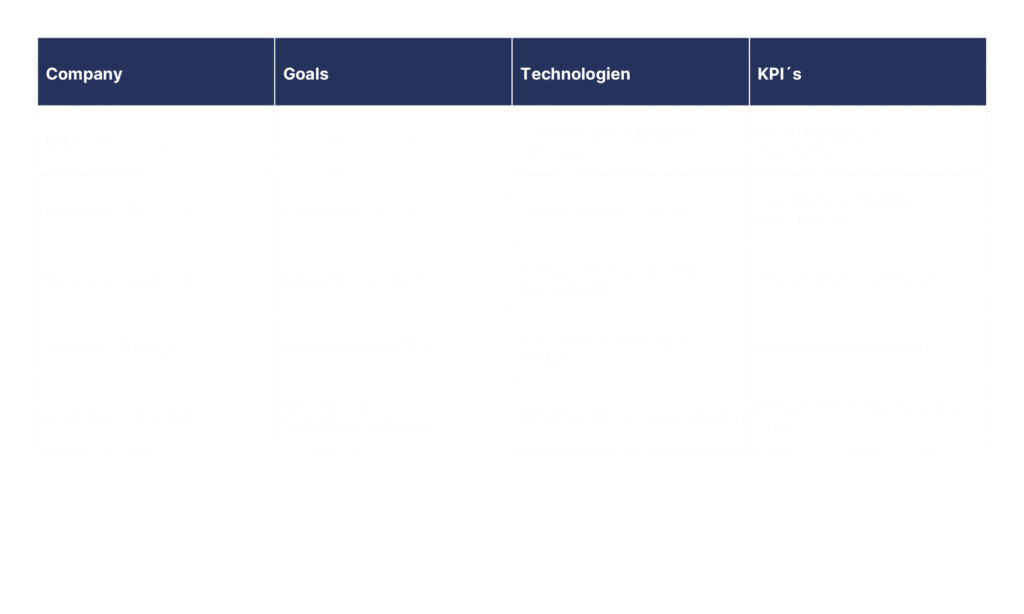
This article does not provide abstract concepts, but analyses five specific smart factory examples from leading German industries. We take an in-depth look at the strategies of Rittal, Mercedes-Benz, Boehringer Ingelheim, TRUMPF and Audi. You will learn which technologies these pioneers are using, which strategic decisions they have made and, most importantly, what lessons you as a decision-maker can learn for your own company. This will give you a solid basis for your own roadmap to smart production.
Before we analyse the practical examples, it is essential to clearly define the term ‘smart factory’. A smart factory is a fully digitalised and networked production environment in which physical and digital processes merge. Machines, systems and products communicate with each other and with higher-level systems via the Internet of Things (IoT) on a permanent basis. It differs from a traditional factory in three key ways:
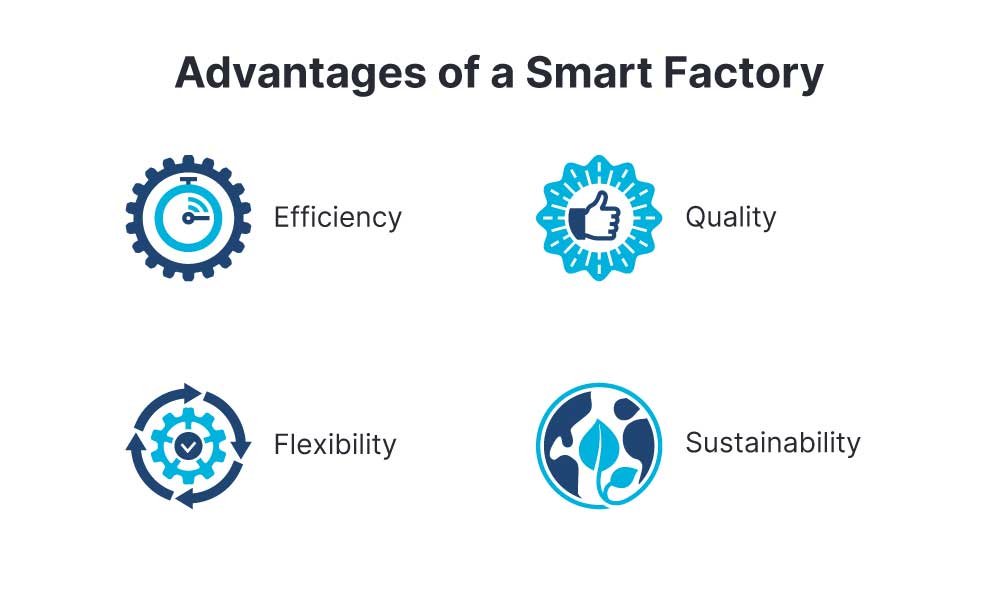
The transition to a smart factory is much more than a technological upgrade. It creates tangible competitive advantages that are relevant for every manufacturing company. The most important advantages include a significant increase in efficiency through optimised processes and reduced downtime, higher product quality through seamless monitoring and zero-defect strategies, increased flexibility for manufacturing customised products, and improved sustainability through optimised use of resources and energy.
The following case studies show how different the paths to the smart factory can be, depending on the industry, product and corporate strategy. Each of these companies provides valuable insights.
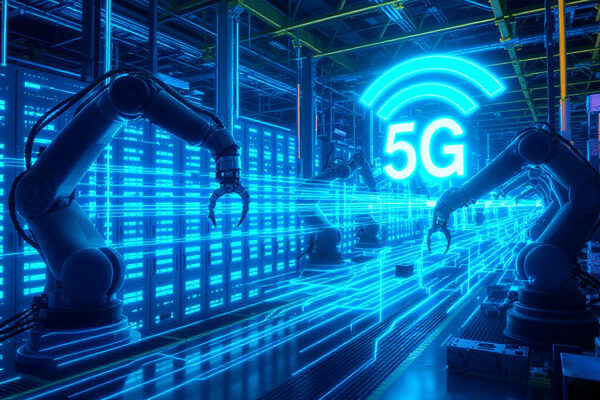
At the Rittal plant in Haiger, where up to 9,000 switch cabinets are produced every day, the focus is on maximum automation. With 250 networked machines and the first private 5G network in German industry, Rittal has created one of the most modern production facilities in Europe. The technological focus is on the private 5G network for extremely fast and secure data transmission and edge computing for processing the 18 terabytes of data generated directly on site. This enables real-time analysis and AI-supported predictive maintenance. The system reports maintenance requirements before a failure threatens to occur. The measurable successes are impressive: production efficiency has been increased by 25%, while plant availability is at 95%. The strategic lesson to be learned from this is that for companies with high volumes, fully automated networking with local data processing is the key to maximum efficiency.
Source: Rittal GmbH & Co. KG (2023): ‘Press release – Haiger plant: Ingeniously digital: Haiger plant impresses with high level of digitalisation’
With Factory 56 in Sindelfingen, Mercedes-Benz proves that the smart factory does not mean the elimination of humans, but rather a new form of collaboration. Instead of a rigid assembly line, flexible production areas (TecLines) are used. Employees use tablets and augmented reality (AR) glasses that project precise assembly instructions directly into their field of vision. IIoT systems connect every corner of the factory and document every single production step. The flexible architecture shortens the time-to-market for new models by 40% and rework has been reduced by 85%. The lesson learned: in premium manufacturing with a high degree of variety, the combination of human expertise and digital support is the key to flexibility and the highest quality.
Source: Mercedes-Benz Group AG (2020): ‘With its Factory 56, Mercedes-Benz is presenting the future of production,’ 2 September 2020.
The pharmaceutical industry is subject to extremely strict regulatory requirements. Boehringer Ingelheim’s smart factory was therefore designed with a clear focus on compliance and quality assurance. Intelligent sensor systems continuously monitor all critical parameters. Any deviation from the target value is automatically detected and documented in full for audits, including the corrective measures taken. The time required to prepare for audits has been reduced by 70% and human errors in documentation have been virtually eliminated. For industries with high compliance requirements, the smart factory is the ultimate tool for making processes transparent, secure and verifiable.
Source: Boehringer Ingelheim (2021): ‘The next stage of pharmaceutical production – The Solids Launch Factory (SOL) as a smart factory,’ Annual Report 2021
At its headquarters in Ditzingen, machine tool manufacturer TRUMPF demonstrates that smart factories do not have to be the preserve of large corporations. A realistic, networked sheet metal production facility covering 6,000 m² is on display, tailored specifically to the needs of small and medium-sized enterprises (SMEs). The approach is deliberately modular. TRUMPF shows how companies can gradually move towards networking – from the simple connection of individual machines to fully integrated smart production with driverless transport systems. At the heart of it all is the TruTops Fab software, which acts as a central production management system. The lesson: getting started with Industry 4.0 doesn’t have to be a radical change. A modular, step-by-step approach based on an open software platform significantly lowers the barriers to entry.
Source: TRUMPF GmbH + Co. KG (2020): ‘TRUMPF opens new Smart Factory in Ditzingen,’ press release, 23 October 2020.

Audi is driving forward the development of the smart factory in its own Production Lab (P-Lab) in Ingolstadt. Here, innovative technologies such as 5G, cloud solutions for production and AI applications are tested under real conditions before being transferred to large-scale production. A central focus is on human-machine collaboration. According to P-Lab director Henning Löser, vehicle construction remains a “craft” in which intelligent assistance systems support employees rather than replace them. A concrete example is the Battery Monitoring Analysis Necessity (Battman) software at the Brussels site, which analyses high-voltage batteries in real time, eliminating long waiting times. Audi demonstrates that the smart factory is a continuous innovation process driven by targeted experimentation and close cooperation between development and production.
Source: Audi AG (2022): ‘Audi Production Lab: the link between idea and large-scale production,’ press release (8 August 2022)
The examples presented are inspiring, but how can they be implemented in your own company? Integrating legacy systems, ensuring data security and a lack of internal expertise are often the biggest hurdles. This is where specialised partners such as Procom-Automation GmbH come into play. With over 40 years of experience in automating manufacturing companies, they bridge the gap between vision and reality.
As experts in CNC control solutions and IIoT systems, Procom-Automation knows the challenges of manufacturing first-hand. With the Clouver IIoT platform, a tried-and-tested software solution has been created that enables a quick and easy entry into digitalised production. Clouver is used for real-time production monitoring, helps to minimise downtime and increases the efficiency of the entire production process. A key advantage is the Clouver SmartKit, which enables even older and heterogeneous machines to be seamlessly integrated into a modern Industry 4.0 landscape. Instead of expensive new investments, existing production facilities can be made ‘intelligent’. This expertise, gained from decades of experience, makes Procom-Automation an authentic and trustworthy partner for digital transformation.
The examples presented clearly demonstrate that the digital transformation of production is not a pipe dream, but a tangible competitive advantage. Your first step is not to invest in technology, but to take an honest inventory. Conduct an assessment of your existing IT infrastructure, use benchmarking to identify best practices relevant to your industry, and develop a roadmap with measurable milestones.
The complexity of such a transformation can be overwhelming. But you don’t have to go it alone.
Are you ready to evaluate the potential of a smart factory for your company? Contact us for a no-obligation initial consultation. Our experts at Procom-Automation will help you develop a tailor-made strategy that builds on the successes of market leaders and perfectly suits your individual requirements.