Implemented in record time: customised CNC solution thanks to close cooperation with Balacchi Srl
7. June 2024
Balacchi Srl, a leading manufacturer of precision machinery, faced the challenge of modernising its CNC controls in Italy in order…

27. January 2026
Update November 2026
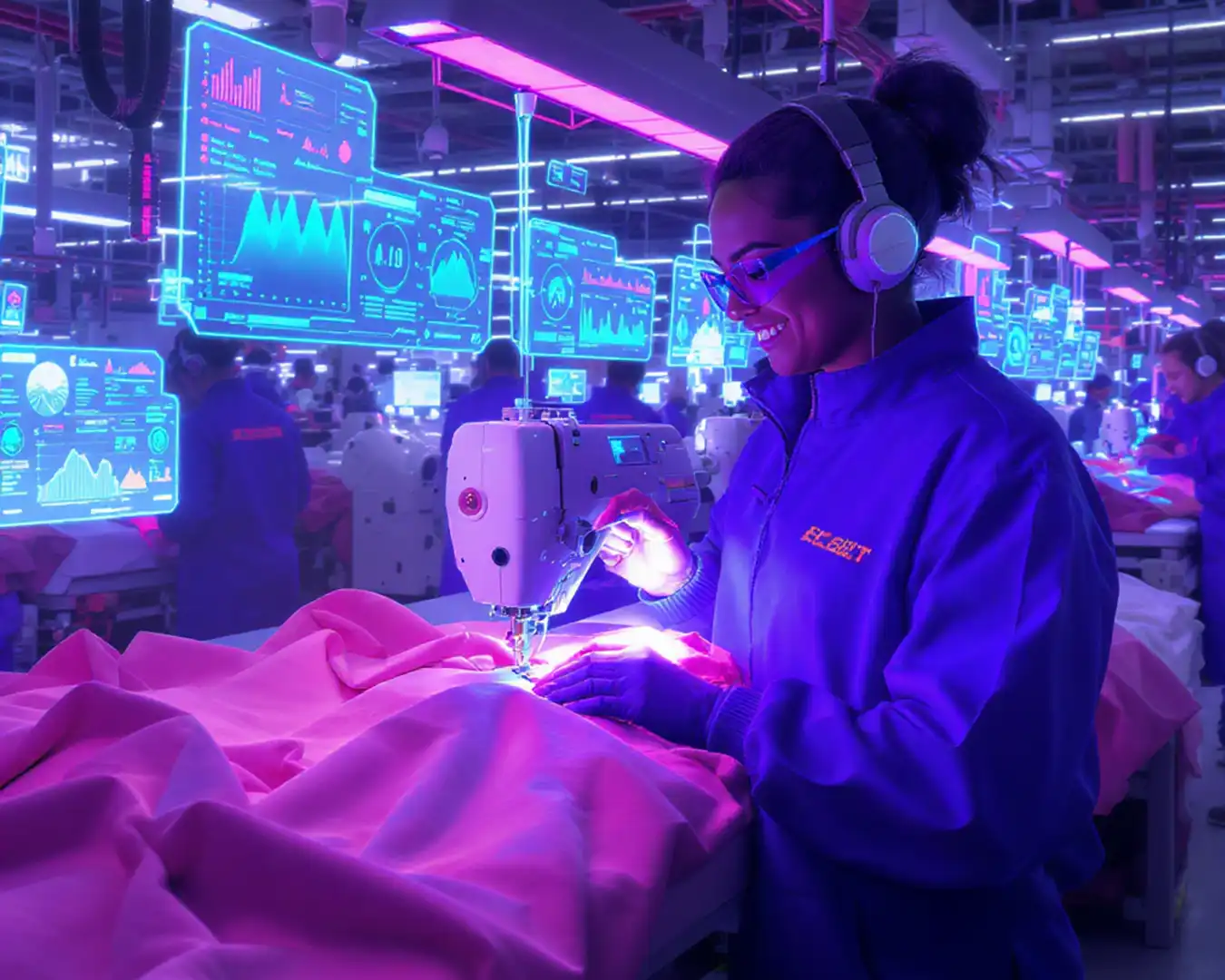
A garment production monitoring system records what every sewing machine on a line is doing while the shift is running: output, stops and defects per station. It is made for factory and production managers who today get these figures from paper and Excel after the shift. Clouver connects existing sewing machines with SmartKit TEXTILE, without changing the machine logic and without replacing the ERP. In a 12-week pilot on an automotive sewing line in India, output per productive machine-hour rose by 9.3% and defects per hundred units fell by 31.5%.
See what the system shows: the Clouver TEXTILE Production Cockpit documentation presents all eight views for sewing lines, with screenshots from a running production line.
Demands on modern sewing operations continue to rise. Global supply chains, shorter lead times and cost pressures make seamless transparency across the production process a basic requirement. Especially in the garment industry, where manual labour dominates, traditional control tools and paper-based tracking are no longer sufficient.
A Garment Production Monitoring System provides a solution: it delivers real-time data on machine availability, productivity and root causes of stoppages directly from the sewing line. Operators and production managers can make informed decisions based on live data and measurably increase their Overall Equipment Effectiveness (OEE). The combination of thread monitoring, seam monitoring and automated analytics allows comprehensive monitoring and evaluation of the entire sewing process.
Industrial textile production is defined by high demands on precision, speed and consistent quality. Varying materials, changing batch sizes and complex workflows make sewing a technical challenge. Seam quality largely depends on factors such as thread tension, thread guiding, machine configuration and the sewing machine accessories in use. Embroideries and special applications also require the highest accuracy.
Common types of sewing machines include models from manufacturers such as Brother, Juki, Dürkopp Adler and Pfaff. Clouver has been connected to more than 20 machine models from these and other brands, legacy and new. Other models can be connected as well. The system has been technically developed to provide a reliable data basis, even in demanding production environments.
An automotive supplier in India connected one sewing line with ten machines to Clouver for twelve weeks. The table compares week 4, the first full production week, with week 12.
| Metric | Week 4 | Week 12 | Change |
|---|---|---|---|
| Output per productive machine-hour | 12.04 pieces | 13.16 pieces | +9.3% |
| Non-productive time (share of machine time) | 36.5% | 31.0% | -5.5 percentage points |
| Defects per hundred units (DHU) | 3.02 | 2.07 | -31.5% |
| Machine stops per week | 8,335 | 6,660 | -20% |
The figures come from one line and one product and are not a forecast for other factories. The full analysis of downtime, quality and energy is in the automotive sewing case study.
Planning a pilot on your own line? Download the Clouver Pilot Playbook for Sewing Factories.
Tactical Solutions is a growing production company based in Europe with international customers. As its capacity expanded, the company wanted to see production performance, line utilisation and downtimes from any location and on any device.
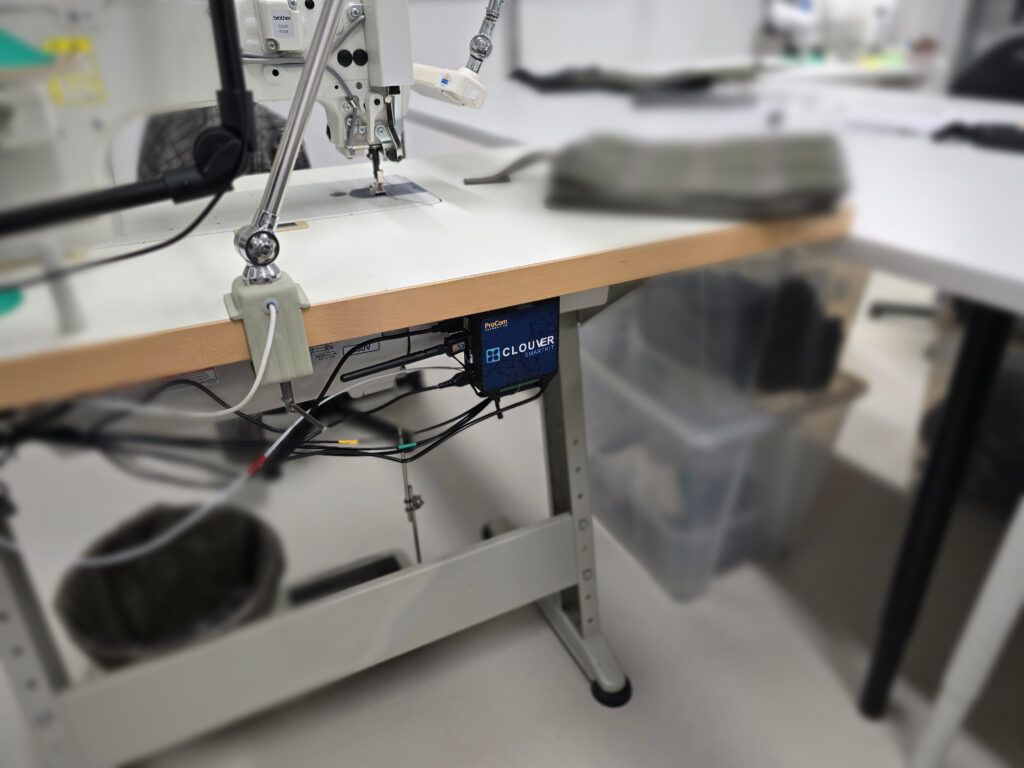
The requirement was to connect all existing industrial sewing machines to one monitoring system without affecting the warranty or interfering with the machine controls. Clouver reads the data non-invasively, so the machines and their controls stay unchanged. The integration was carried out in close coordination with the customer and linked to the existing ERP system. As an MES for garment manufacturers, Clouver offers a practical tool for managing manufacturing data centrally and ensuring consistent transparency on the shop floor.
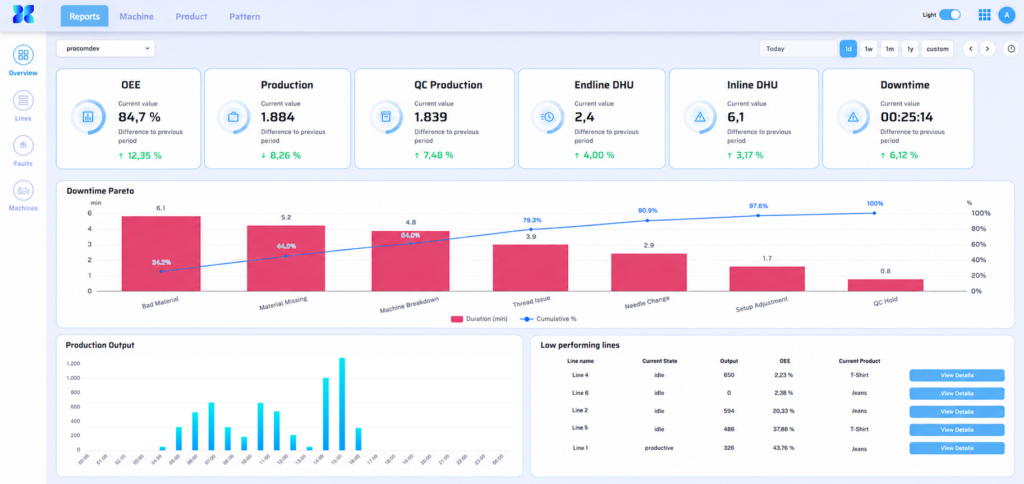
In the event of a fault, Clouver automatically alerts the line supervisor. If there is no acknowledgement within a defined timeframe, the system escalates the incident to management.
With consistent data capture, Clouver provides a robust foundation for optimising OEE figures. Production lines can be compared directly, bottlenecks identified and improvement actions initiated based on factual evidence. The system architecture supports automated evaluations and performance assessments related to production efficiency and error detection.
Where does your line stand today? Work out your current OEE with our free Excel calculator.
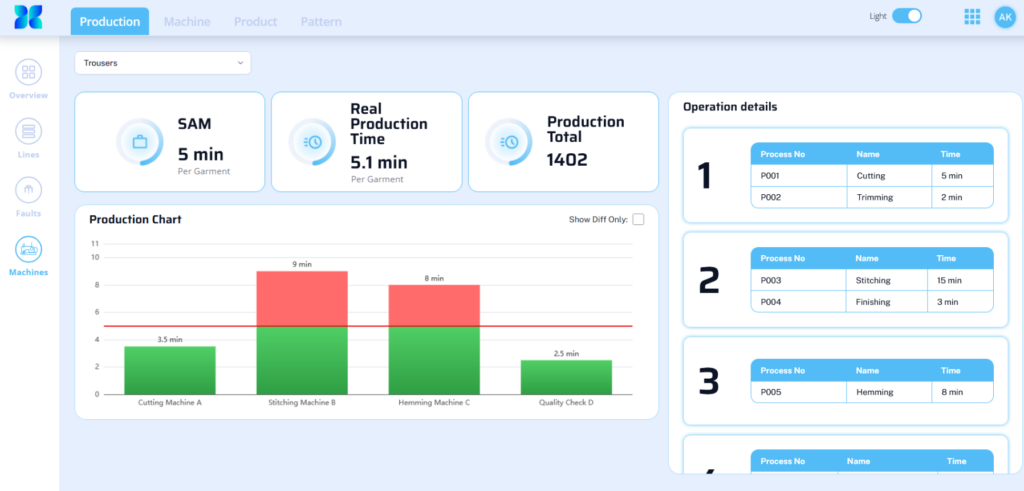
Clouver also enables direct comparison of production lines in terms of their utilisation, efficiency and downtime. This allows differences between lines to be identified and the causes of performance deviations to be pinpointed. This comparative data helps production managers to introduce targeted measures to increase efficiency and set benchmarks within the plant.
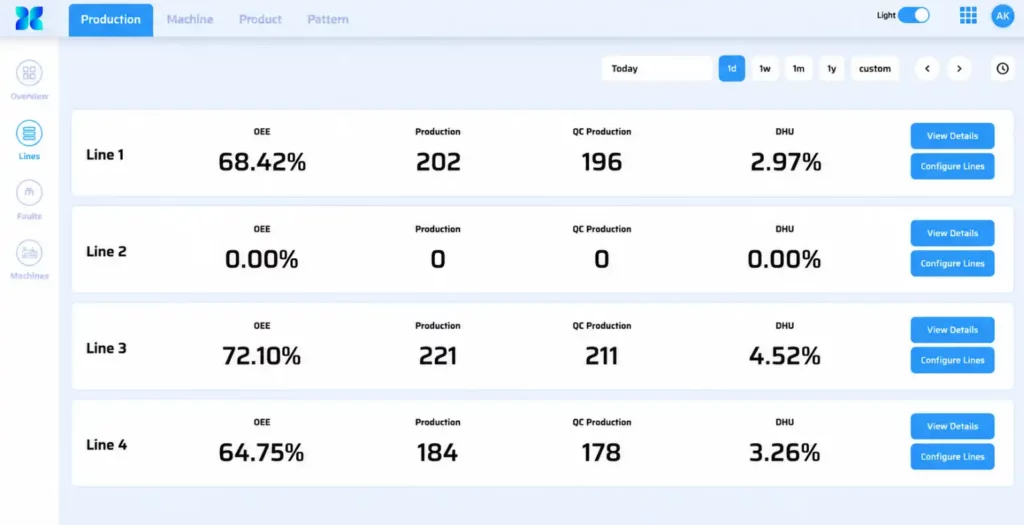
Clouver is modular and can be expanded with additional machine types, production lines or functions. This is particularly relevant for multi-site manufacturers or businesses in scaling phases. Additional sensors for thread monitoring or seam monitoring can be integrated flexibly.
Integration into existing IT and production environments is achieved with minimal downtime. The cloud-based architecture enables a rapid rollout – even across distributed production facilities. In this way, the digitalisation of the sewing shop can be implemented step by step.
Production and operations managers receive valid key figures on output, availability, failure patterns and line efficiency – detailed down to each workstation. Common causes such as inconsistent thread guiding or poorly adjusted thread tension can be identified and corrected over time.
Clouver not only detects machine downtime but also evaluates product quality and material consumption in real time. This enables manufacturers to optimise their production processes and sustainably increase output. Especially for high-end textiles, the combination of intelligent technology and real-time data ensures greater reliability in manufacturing.
Yes. Clouver connects sewing machines through SmartKit TEXTILE, a device at each machine that reads data without changing the machine or its control unit. More than 20 machine models from brands such as Brother, Dürkopp Adler, Juki, Pegasus and Pfaff have been connected so far. Other models can be connected as well; the first connection of a new type takes a little longer.
No. Clouver adds live shop floor visibility while your ERP and other systems remain in place. It supplies what the ERP cannot see: machine data, production status and quality figures during the shift.
The operator logs in at the station at the start of the shift and selects a reason with one tap when the machine stops. Quality control marks each piece as pass or defect. Stitches, pedal presses and cuts are counted automatically, and the touchscreen shows the status of the station, for example units, cycle time and DHU.
Per line: output per hour against target, downtime by cause, defects per hundred units (DHU) and energy per machine. Per station: seconds per piece, which shows the bottleneck, and defects per machine. Line leaders see these figures while the shift is running. How to use them for line balancing in sewing factories is described in a separate guide.
A pilot runs in four phases: preparation, about one week of installation, four weeks of evaluation with a weekly review meeting, and an impact review based on your own figures. You provide one line, a machine list, Wi-Fi on the shop floor, a gateway device and an LTE router, and contacts for production, maintenance and IT. The Clouver Pilot Playbook for Sewing Factories describes each phase.
Do you run a sewing workshop or clothing factory and want to know how Clouver can increase your transparency and efficiency? Then find out more on our Clouver product page or contact us directly.

About the Author
Tanja is Head of Digital Marketing at ProCom Automation and writes practical articles on CNC, IIoT, Industry 4.0 and efficient manufacturing. The content is developed and technically reviewed in close collaboration with our Clouver IIoT monitoring and CNC experts.



You are currently viewing a placeholder content from Google Maps. To access the actual content, click the button below. Please note that doing so will share data with third-party providers.
More InformationYou are currently viewing a placeholder content from OpenStreetMap. To access the actual content, click the button below. Please note that doing so will share data with third-party providers.
More InformationYou are currently viewing a placeholder content from Facebook. To access the actual content, click the button below. Please note that doing so will share data with third-party providers.
More InformationYou need to load content from reCAPTCHA to submit the form. Please note that doing so will share data with third-party providers.
More InformationYou need to load content from Turnstile to submit the form. Please note that doing so will share data with third-party providers.
More Information